Disney World's District Is Selling Its Decommissioned Power Plant Equipment for $22 Million to Clear Space for Expansion
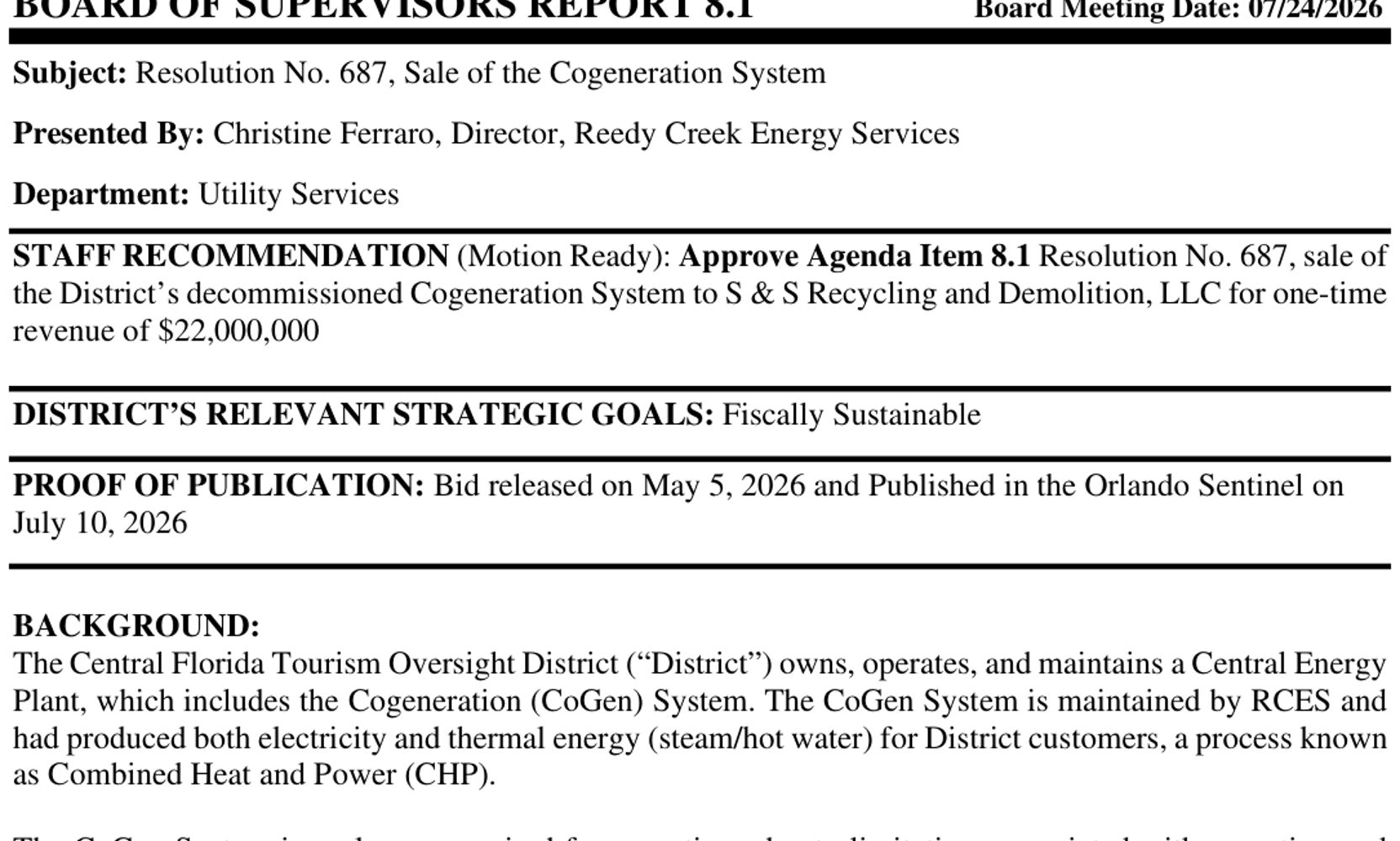
Walt Disney World's governing district is selling the cogeneration power system that once generated electricity and steam for the resort, and the buyer is a power plant demolition firm. Resolution No. 687, a public hearing item on the Central Florida Tourism Oversight District's July 24 board agenda, approves the sale of the decommissioned CoGen System at the district-owned Central Energy Plant to S&S Recycling & Demolition, LLC for one-time revenue of $22,000,000. The staff report spells out why in a single sentence: the system "is being sold to recover remaining asset value and create space for future expansion."
Parks Magic found the sale in the district's July 24 Board of Supervisors packet, where it sat almost entirely unnoticed. July 24 was a busy day at the district: the heavy coverage went to a different action entirely, the planning board's same-day recommendation of land development regulations that would cap Disney World's growth through 2045 (we covered that item here). The power plant sale sat in a different document, on a different board's agenda, and as far as we can tell no other outlet has reported it.
Quick facts: Sale of the CoGen System at the Central Energy Plant (5300 N. Center Drive, north of Magic Kingdom). Buyer: S&S Recycling & Demolition of Mansfield, LLC (the staff report's bid table lists a Kissimmee address, the contract an Orlando one). Price: $22,000,000, paid as a $500,000 deposit at signing plus $21,500,000 within 30 days. The buyer must remove everything and restore the site before March 31, 2027.
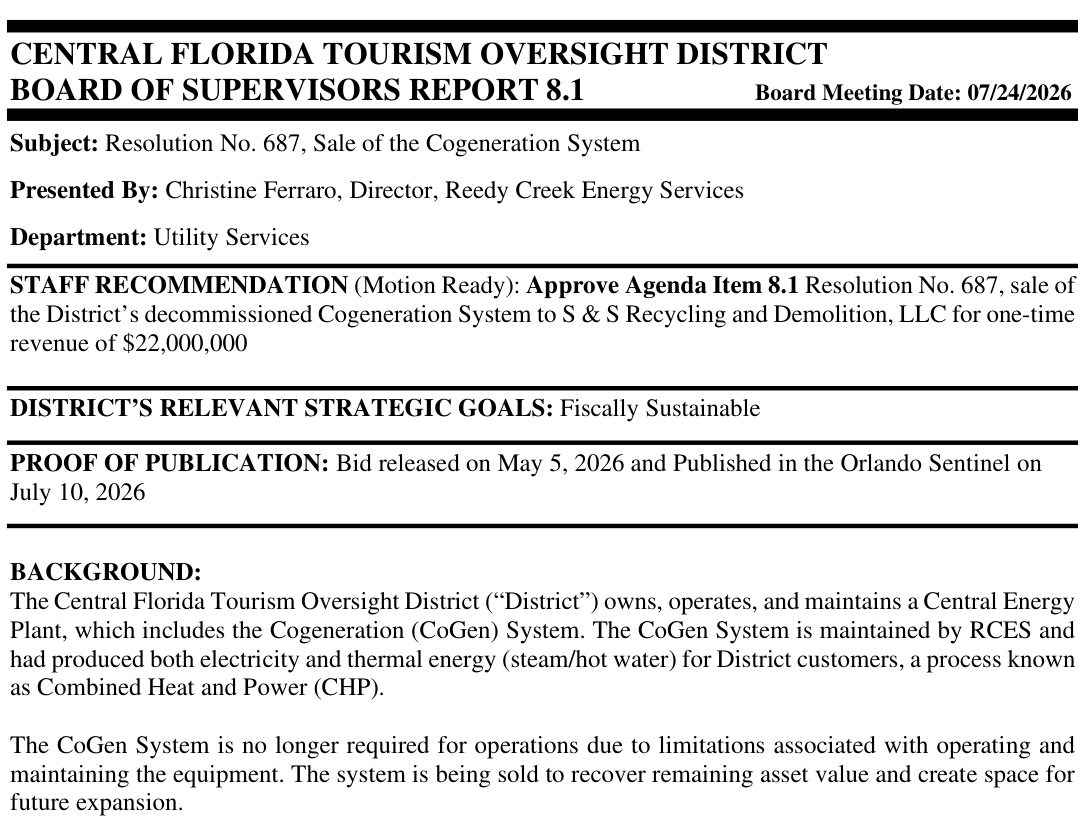
The staff report for agenda item 8.1. Credit: Central Florida Tourism Oversight District board packet
A demolition firm outbid GE by $15.5 million
The district issued Request for Proposals #C007075 on May 5 seeking buyers for the CoGen System, with proposals due June 12 and a public selection committee meeting held June 15. Six offers came back, and the spread is remarkable:
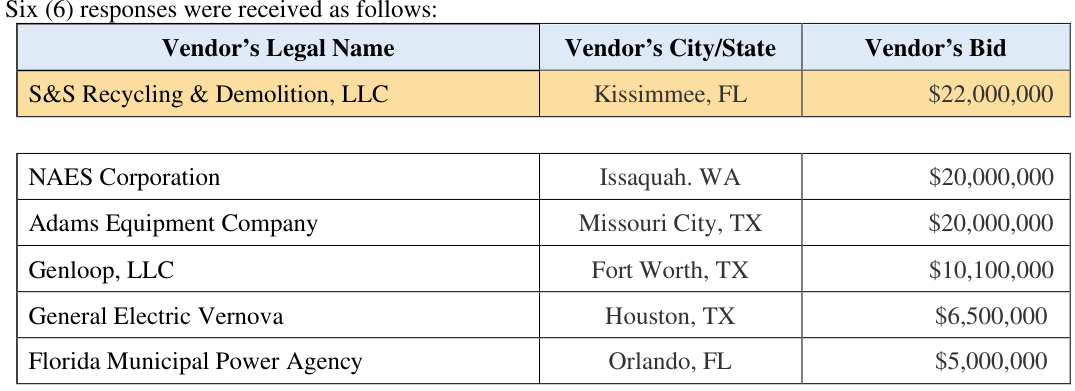
All six responses to the district's request for proposals. Credit: Central Florida Tourism Oversight District board packet
S&S Recycling & Demolition offered $22 million. NAES Corporation, one of the country's largest independent power plant operators, offered $20 million, as did Texas equipment dealer Adams Equipment Company. Genloop, LLC offered $10.1 million. General Electric Vernova, GE's spun-off power and energy business, offered just $6.5 million. Florida Municipal Power Agency, the Orlando-based utility consortium, came in last at $5 million.
Four of the six went through committee scoring, where the purchase price counted for 65 of 100 points. S&S scored a 96 composite against NAES's 91, and the packet's evaluation sheet carries the formal line: "INTENT TO AWARD: S & S Recycling & Demolition LLC."
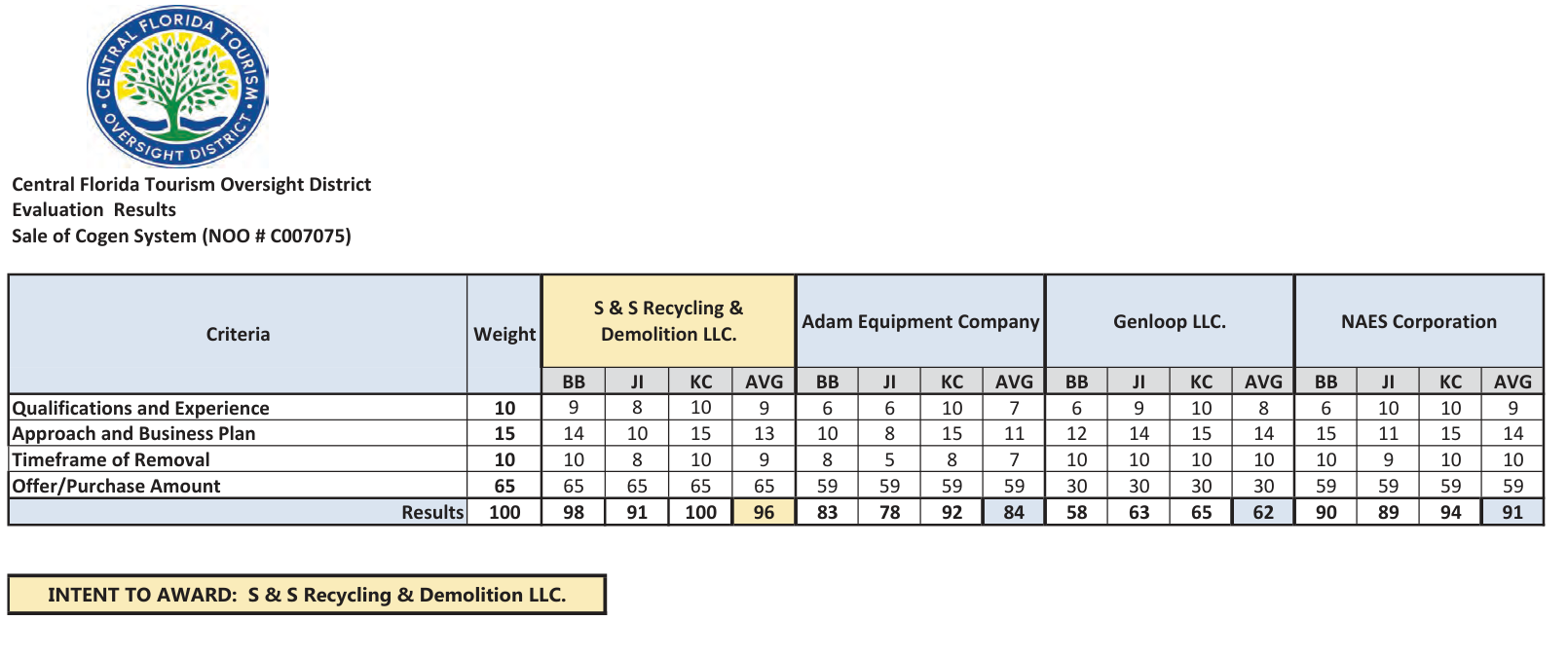
The selection committee's scoring chart. Credit: Central Florida Tourism Oversight District board packet
The winning bidder is not a household name. S&S's own proposal, included in the packet, describes the company as an energy sector decommissioning and demolition specialist established in 2013 with completed projects "on numerous power plant sites," and the company estimates finishing the entire removal within six months of receiving its notice to proceed.
What exactly is being sold
The equipment list reads like the heart of a power station, because it is one: the gas turbine, the gas turbine generator, the steam turbine, the heat recovery steam generator, the reverse osmosis water treatment system, the generator step-up transformer, and spare parts. Together they formed a combined heat and power installation that produced both electricity and thermal energy (steam and hot water) for district customers, with Walt Disney World as the obvious anchor.
According to the resolution, the district has not used the generator to produce electric or thermal energy since 2024, and both the district administrator and Leidos, the district's consulting engineer, have certified in writing that it "is no longer necessary or useful or profitable" to the utility system. Because the equipment is part of the bond-financed utility system, the resolution walks through the formal findings required by the trust indenture backing the district's utility revenue bonds, a document that dates to November 1, 1987, including certifying that the price exceeds one percent of the gross book value of the system's fixed assets.
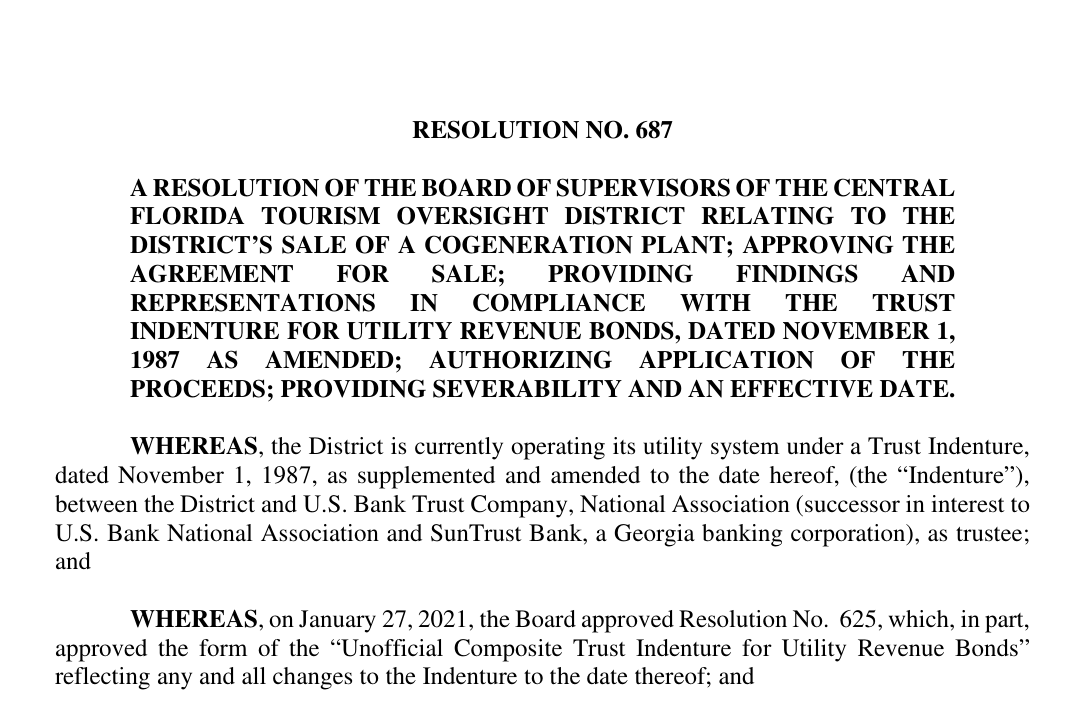
Resolution No. 687. Credit: Central Florida Tourism Oversight District board packet
The contract puts every burden on the buyer: decommissioning, isolation, dismantling, rigging, protecting the buildings around the work, transportation, removal, and restoring the site to its prior condition. All of it must be finished before March 31, 2027, and S&S has to post performance and payment bonds before touching anything.
The plant was once literally called an attraction
When this system was new, the trade press treated it as a marvel. A September 1988 Electrical Systems Design article, preserved by the Disney history archive D-I-X, ran under a headline declaring the cogen plant "A New Attraction At Walt Disney World." It described a 40 megawatt combined-cycle installation built around a General Electric LM5000, an aeroderivative gas turbine based on GE's CF6-50 jet engine, generating 33,500 kilowatts on its own and paired with an 8.4 megawatt steam turbine running on the gas turbine's recovered heat. At design time, the plant was projected to serve approximately 55 percent of the Disney complex's electrical load and to more than triple Reedy Creek's generating capacity. The article was written while the system was still being built, and we could not pin down the exact year it entered service.
The world changed around it. The district has been layering in renewable and purchased power for a decade, including a five megawatt Duke Energy solar facility near EPCOT announced in 2016 and the 50 megawatt solar farm near Animal Kingdom that came online in 2019, alongside power bought from the grid. This month's staff report cites "limitations associated with operating and maintaining the equipment" as the reason the CoGen System is no longer required.
What "future expansion" means here
Two separate lines in the packet point the same direction. The staff report says the system is being sold partly to "create space for future expansion." And the resolution directs where the $22 million goes: first to top up the utility system's renewal and replacement fund, then into "a fund designated by the District for application to the costs of future expansion of the System," with anything left over going to debt service.
To be precise, "the System" in that sentence is the district's utility system, not the theme parks. But the reason the utility system needs expanding is not a mystery. The same district is currently processing permits for the biggest construction wave Walt Disney World has seen in decades, including the Cars-themed Piston Peak at Magic Kingdom, Monstropolis at Hollywood Studios, and Tropical Americas at Animal Kingdom, plus new hotel capacity, and the same board packet elsewhere describes new customer connections driving increased chilled water demand at another of the district's energy plants. One reading of this sale, and we want to be clear this is our interpretation rather than anything the district has said, is that the district would rather clear the Central Energy Plant floor for infrastructure that serves that growth than keep paying to maintain a mothballed power station.
What we don't know
The board packet tells us what was scheduled for a vote, not what happens next. Open questions we could not answer from the public record:
The final vote. The item went to the board as a public hearing with a motion ready staff recommendation to approve, and nothing suggests opposition, but confirming the outcome is genuinely difficult: the district stopped livestreaming its board meetings after February 2026, citing low viewership, as of publication its YouTube channel had no recording of the July 24 session, and minutes will not be adopted until the board's next regular meeting on August 28. We will update this story once the outcome is confirmed.
Why two bidders were not scored. The staff report lists six responses, while the evaluation chart scores only four, and the purchase agreement's recitals say four proposers responded. The packet never explains what happened to the other two.
What happens to the turbines. The documents never say what will become of this specific equipment. But the resale path looks real: S&S's proposal touts an asset recovery division with "established relationships with buyers and end users" for selling surplus turbines, transformers, and complete plants, which would help explain how a demolition firm could outbid two power industry buyers by millions. Whether these particular machines find a second life or get cut apart is not addressed anywhere in the packet.
What fills the space. Neither the staff report nor the resolution says what the district intends to build in the plant once the equipment is gone.
Sources
Everything about the sale comes from the Central Florida Tourism Oversight District's public records: the July 24, 2026 meeting agenda and the Board of Supervisors meeting packet (agenda item 8.1, Resolution No. 687, and the attached purchase agreement, Contract No. C007075), available on the district's board documents page. The sale was publicly noticed in the Orlando Sentinel on July 10, 2026, per the staff report's proof of publication. Historical background comes from the September 1988 Electrical Systems Design article preserved by the D-I-X archive, Duke Energy, PV Tech, and BlogMickey's reporting on the district ending its meeting livestreams.