Disney Patent Filing Would Let AI Spot an Animal Doing Something and Alert Your Phone, and It Could Reroute the Tour Vehicle
On page three of a Disney patent application published this morning is a sentence about a tour vehicle changing where it is going because a computer noticed something.
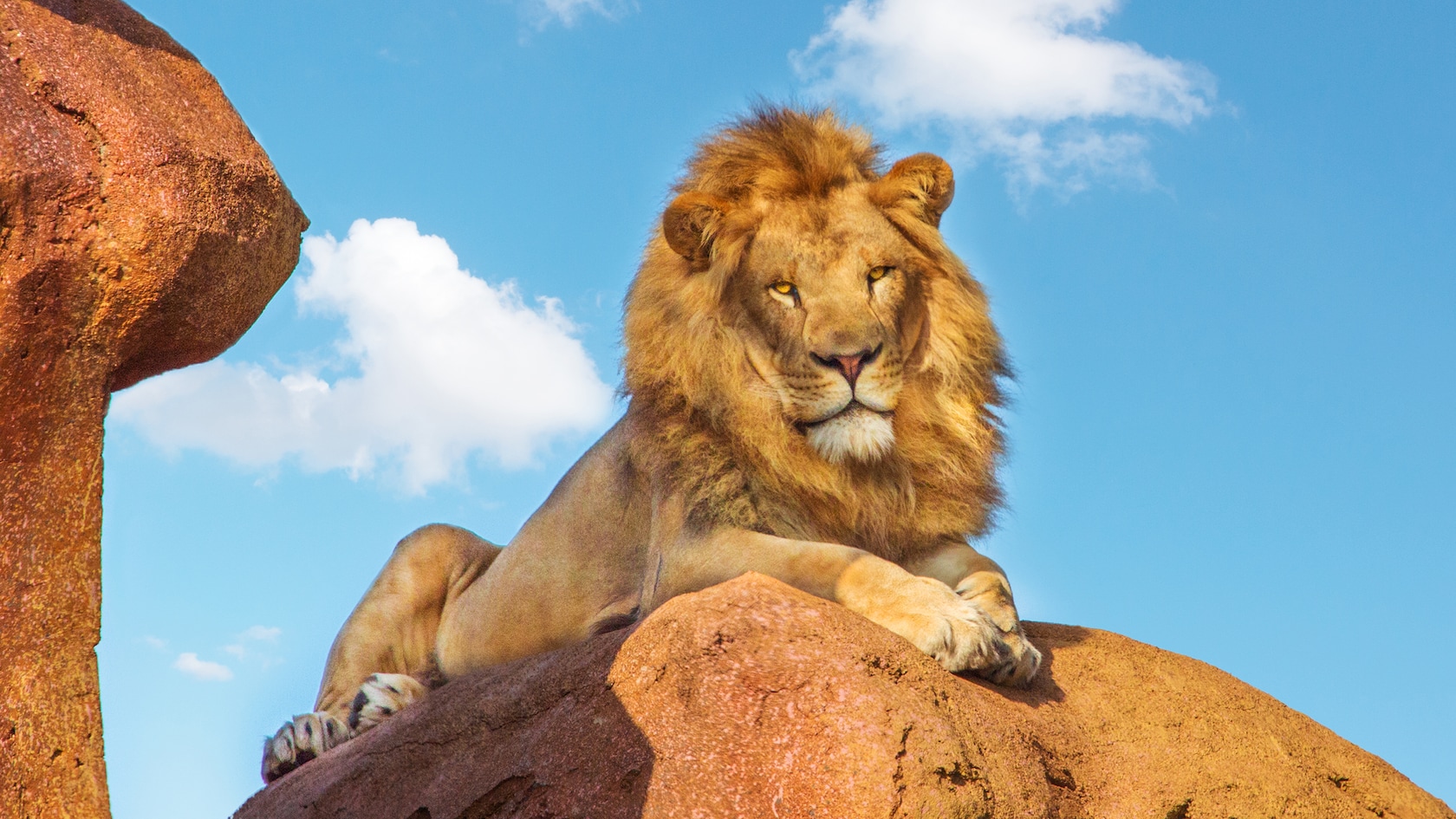
A lion resting on a rock outcrop. The filing is about spotting what an animal is doing, including doing nothing. Photo: Disney
The United States Patent and Trademark Office published Disney Enterprises, Inc.'s application US 2026/0283118 A1 on September 24, 2026, under the title "TECHNIQUES FOR AUTOMATICALLY MONITORING ANIMAL BEHAVIORS AND GENERATING NOTIFICATIONS." It is application 19/084,604, filed March 19, 2025, which puts it right on the standard 18 month publication clock. Three inventors are named: Ching-Chien Chen of Arcadia, California, Isabelle Victoria Wang of Granada Hills, California, and Jeremy Eaton of Winter Garden, Florida.
This is a published application, not a granted patent, and publication is not approval. Treat it as a look at what somebody at the company thought was worth protecting, not as an announcement.
What it actually describes
Cameras watch an "animal encounter enclosure" continuously. The images go to an "animal monitoring platform" running a trained machine learning model, which works out which animals are in frame and what they are doing. If what it finds clears a bar, it sends you a message.
The bar is not a hand wave. Claims 2 and 16 have the system compute a score for the detected animal or behavior and only fire the alert "in response to the score satisfying a threshold." Claims 3 and 17 let that score depend on where your device is standing. Claims 4 and 18 let it depend on a user preference. Claim 14 has the notification tell you the animal's physical location, not just that something happened.
Paragraph 23 spells out what a preference looks like in practice: notifications can be targeted using "animal behaviors and/or specific animals indicated to be of interest to a guest associated with that particular smartphone 164 or tablet device (e.g., animal behaviors associated with a favorite animal indicated in a user profile or otherwise declared by a particular guest)." Tell the app which animal you came for, get pinged about that animal.
On the model side, claim 5 covers feeding the images and "a text question relating to animals" into a trained generative model, which is a plain description of asking a vision model a question in ordinary language about what the camera can see. Claim 6 covers an object detection model and claim 7 a keypoint detection model. Claim 9 lets the whole thing be gated further by motion filtering. The description's only example of that runs the other way: paragraph 43 says motion filtering "can be used to detect certain animal behaviors, such as animals that are not moving."
The description gets a lot more specific than the claims do, and paragraph 38 is where it happens. It names an actual off the shelf model, OWL-ViT, and walks through handing it a query like "What animals are visible in this image?" It lists predefined questions the system would put to each image, among them "What are the animals doing in the image?" and "Is any animal behaving aggressively in the image?" Then it goes a step further and lets you do the asking: a guest or employee could ask, through an app on a wireless device, "What is animal X doing right now?," and that device sends the question off to the monitoring platform to be answered.
Cameras on vehicles and on drones
Claim 13 lists where a camera is allowed to sit: "a camera disposed within an animal enclosure, a camera disposed at a location proximate an animal enclosure, a camera mounted on a vehicle, a camera mounted on an unmanned aerial vehicle, or a camera included in a wireless device."
The drone is in the claims, not just in the description, which is where it counts. Figure 2 draws the whole arrangement: a dotted vehicle path along the top with a boxy open tour vehicle on it, a waterway winding through the middle with a boat on it, a four rotor drone off to the right of a cluster of animals at the water's edge, fixed cameras posted around the perimeter, and a walk up observation area at the bottom.
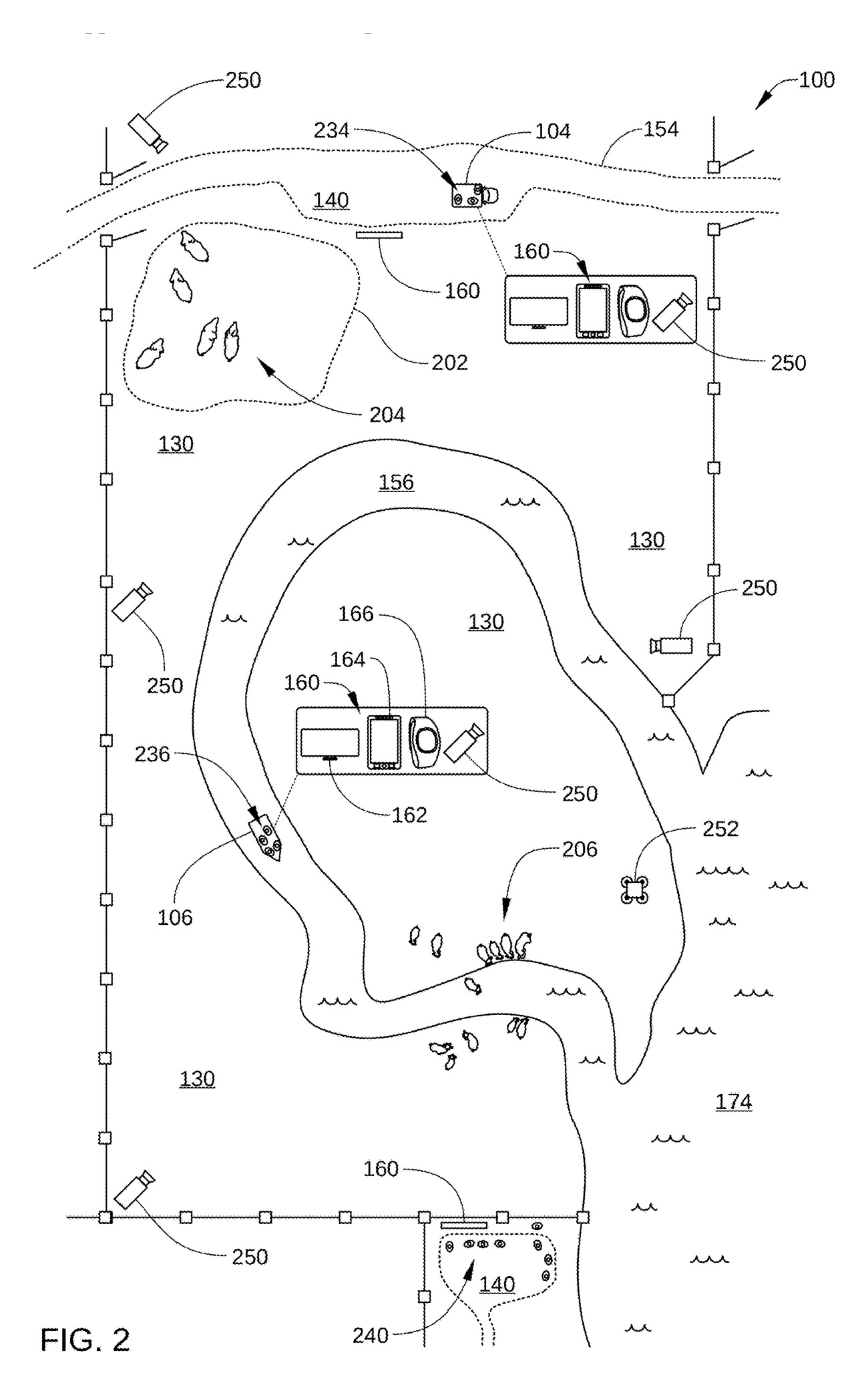
FIG. 2 of the application: vehicle path along the top, boat on the waterway, drone at right, fixed cameras around the fence line. Image: Disney Enterprises, Inc. via USPTO
How you would be told
Claim 12 lists the delivery routes: a text message, a push notification, a message to an app, "a message for display to a vehicle-mounted display device," a fixed display, an email to a server, or a message stored in a database.
The wearable is the odd one. Paragraph 24 says the RFID device "can be implemented as a wrist band, a badge, or other wearable electronic device that is provided by or otherwise associated with animal encounter facility 100," and that it "can display and/or play audio notifications that are curated for the specific guest or employee." A band on your wrist that reads out what the animals are doing.
The part that would change your ride
Paragraph 29 is the one worth reading twice. It sets out the problem plainly: guests riding past in a vehicle can see animals that guests on the boat and guests at the walk up viewing area cannot, and the reverse is true as well. Then it says what the system might do about it.
When an alert lands and the animals are not visible from where you are, the filing says the "vehicle 104 or boat 106 may be driven towards viewing area 202 or a certain portion of waterway 156 upon receiving the notification." And then, flatly: "a planned course for vehicle 104 or boat 106 can be modified in response to receipt of the notification."
That is a tour vehicle taking a different route because a camera saw something. The document's own justification for all of this, in paragraph 30, is that in a conventional facility "animal behaviors can oftentimes be missed because the guest or employee is unaware of the behaviors and/or does not know the exact location of the behaviors."
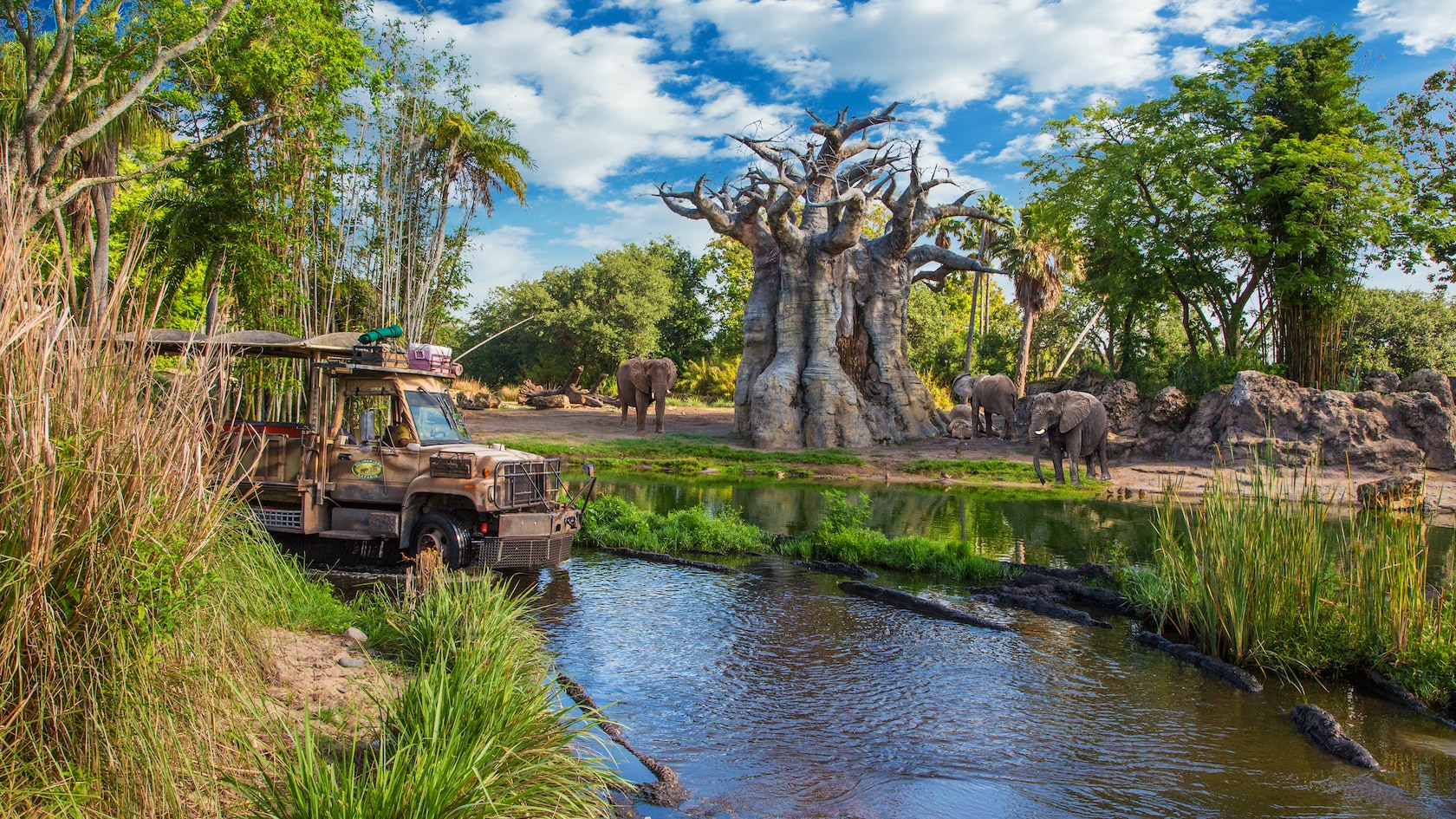
Kilimanjaro Safaris. The filing never names it, or any Disney park. Photo: Disney
The caveat that matters
Nothing in the document ties this to Disney's Animal Kingdom Theme Park. It never says Animal Kingdom, never says Kilimanjaro Safaris and never names a Disney park at all. The only Florida anywhere in it is the two letter state code on one inventor's cover sheet address. Its own term of art is "animal encounter facility."
What you can say is that one of the three inventors lives in Winter Garden, a short drive from Walt Disney World, and that the layout in Figure 2, a vehicle path and a boat on a waterway through one large enclosure, is a recognizable shape to anyone who has ridden Kilimanjaro Safaris. That is inference, not a disclosure. There is also nothing anywhere in the filing about a prototype, an installation or a timeline.
The classifications say plainly what the office took the filing to be about. The application carries the international class A01K 29/00, the catch all "other apparatus for animal husbandry" class, and its CPC entry narrows to A01K 29/005, the subgroup for monitoring or measuring animal activity. Alongside it sit G06V 10/82 and G06V 40/10, which cover neural network image recognition and human or animal body recognition. The background section notes that animal theme parks "combine common theme park elements, such as amusement rides, with classic zoo elements, such as exotic animals that are confined within viewing enclosures," and that those animals "need to be monitored for various reasons, such as identifying aggressive behaviors between certain animals." Guest notifications, in other words, sit on top of a system whose first job is keeping an eye on the animals.
Sources
- USPTO, US 2026/0283118 A1, TECHNIQUES FOR AUTOMATICALLY MONITORING ANIMAL BEHAVIORS AND GENERATING NOTIFICATIONS
- WDWMAGIC, Disney Patent Application Could Alert You When Animals Are Active at Animal Kingdom
- Walt Disney World, Disney's Animal Kingdom Theme Park attractions
Image credits: Lion and Kilimanjaro Safaris photos by Disney. Patent figure by Disney Enterprises, Inc., via the United States Patent and Trademark Office.
Mentioned in this story
Check out our guides for more on each place in this story: