Disney Refiled Its Themed Drone Show Patent and Took the Themed Shell Out of Every Claim
Disney has spent seven years patenting a drone that wears a costume. The filing in that family the patent office published Thursday stops asking for the costume.
On September 10 the U.S. Patent and Trademark Office published application US 2026/0268782 A1, "Themed Aerial Vehicle Entertainment Platform for Providing Dynamically-Coordinated Show," assigned to Disney Enterprises, Inc. It is application 19/018,726, filed January 13, 2025, and its own first line of text states that it is "a continuation of U.S. patent application Ser. No. 16/523,656, filed Jul. 26, 2019." That 2019 application issued as U.S. Patent 12,230,153 on February 18, 2025.
A continuation is a follow-on filing that carries the original description over, with no new matter added, and asks for a different set of claims. The description is the story; the claims are what you actually own. So the interesting part of any continuation is the diff in the claims, and this one is a big diff.
The quick version: the granted 2025 patent has 17 claims built on three independent claims, and all three of them require a physical themed body carried by the drone. The new application has 20 claims built on three independent claims, and not one of them mentions a themed body at all.
What the 2025 patent made Disney own
Claim 1 of U.S. Patent 12,230,153 lists out the hardware, and partway down the list comes the part that mattered: "thematic cladding supported by the chassis wherein the thematic cladding extends around and encloses at least a lower portion of the chassis of the UAV."
In plain English, the drone had to be hiding inside something. Claims 7 and 14, the other two independent claims, each carry their own version of it: claim 7 wants cladding "coupled to and enclosing lower portions of the chassis," and claim 14 wants cladding "supported by the chassis and disguising presence of the UAV." Every one of the 17 claims is one of those three or depends from one of them, so the shell was load bearing across the whole patent. The word "cladding" appears 11 times in the claims.
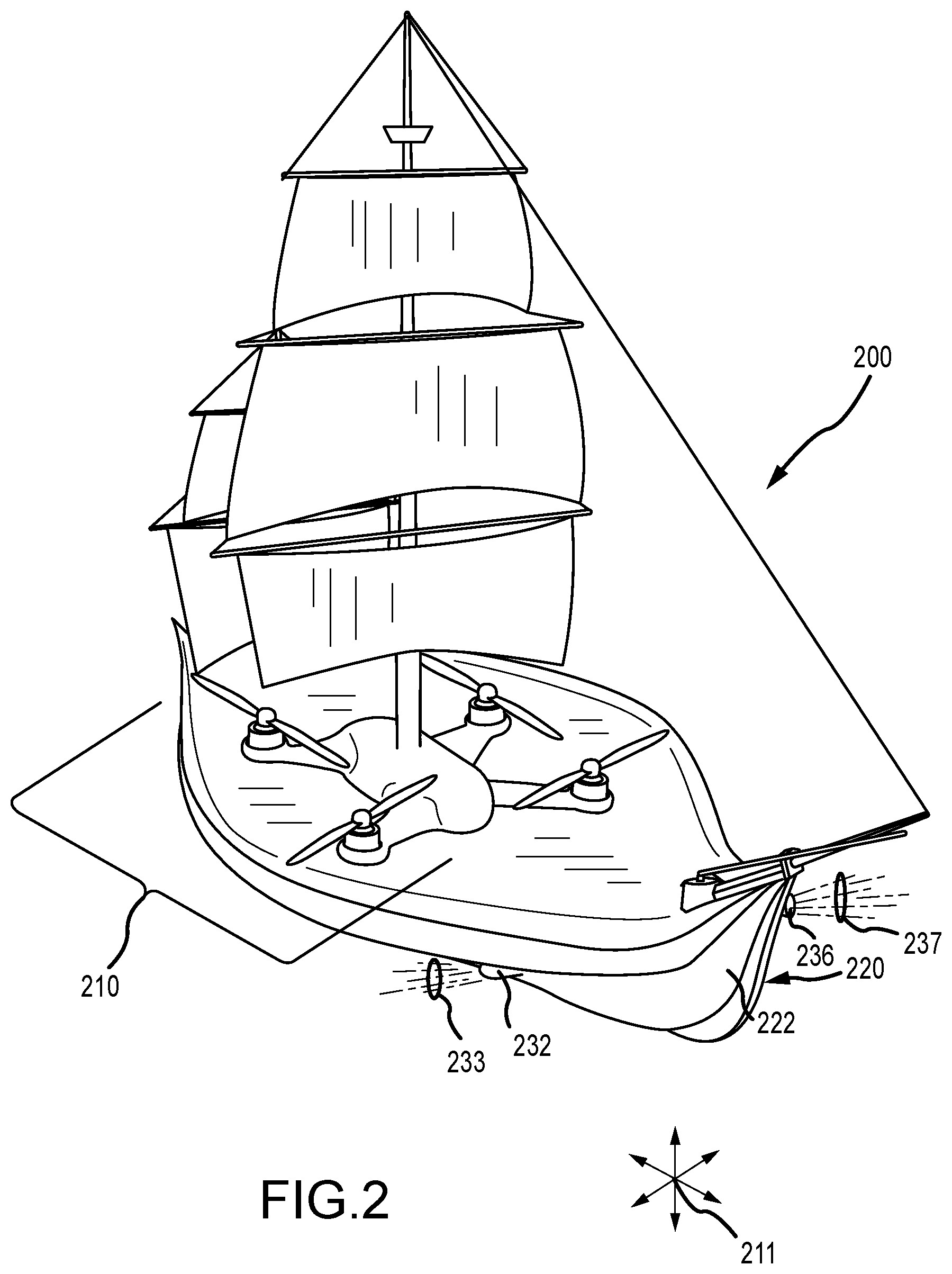
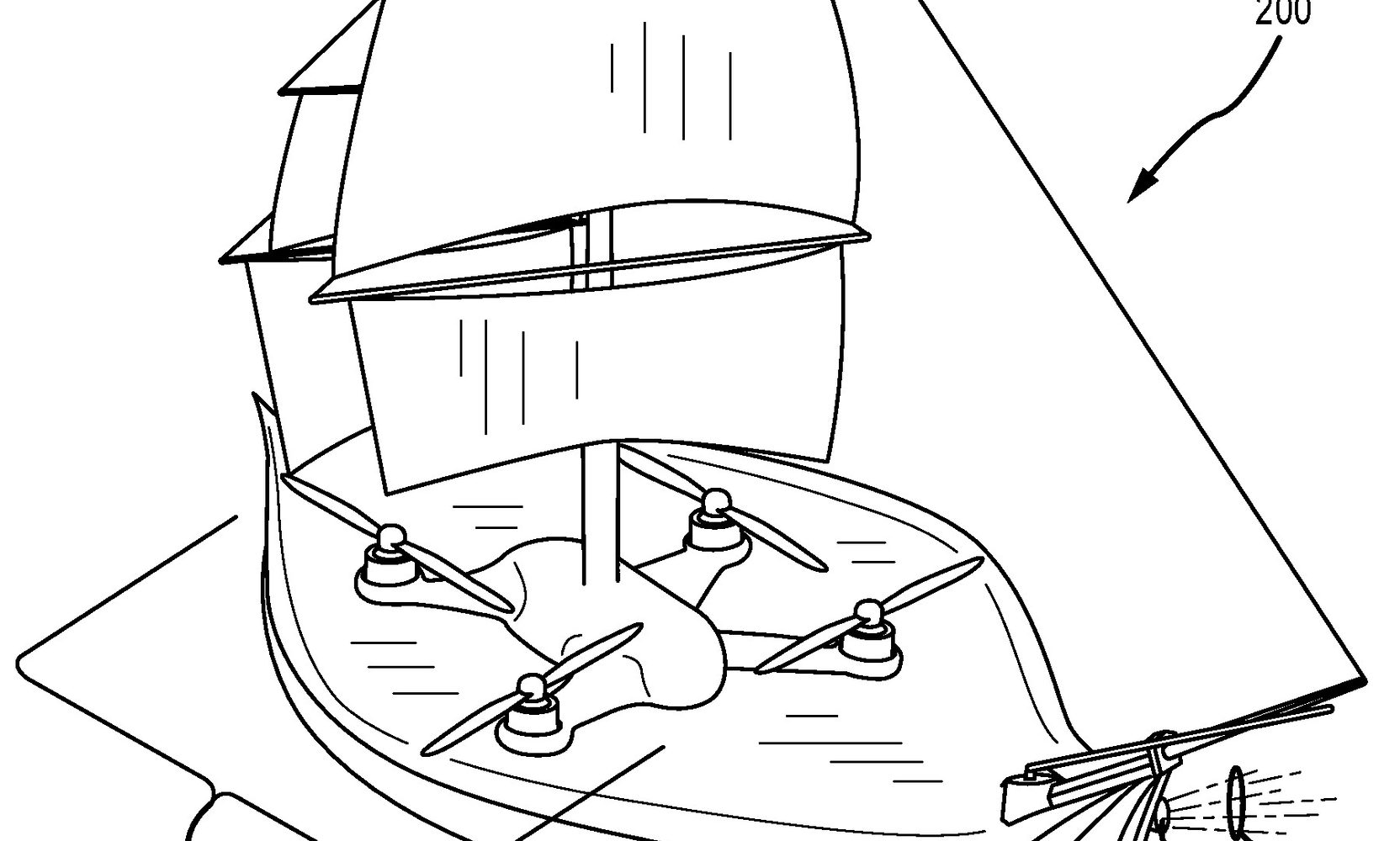
Figure 2 of the granted 2025 patent, and the clearest picture of what "thematic cladding" means: a tall sailing ship shell with a four rotor drone sitting inside the open hull, three tiers of square sails rigged on a single mast above it, and show effect emitters called out at the hull and out past the bowsprit. Credit: U.S. Patent and Trademark Office / Disney Enterprises, Inc.
What the new application asks for instead
Claim 1 of the new publication is a much shorter list. It wants a drone with "one or more show effect devices," a memory holding "a show plan comprising a plurality of alternative scripts," and a show controller that picks which script to run "based on a comparison of the timing signals and location signals with a flight plan, show effect timing defined in the show plan, and show effect locations defined in the show plan."
No shell. No sails. No character body. What these claims cover is the behavior, not the costume: a drone that carries several versions of the show and decides in the air which one to perform.
The abstract calls the fallback version by its showbiz name. The dynamic adjustments, it says, "may involve selecting or generating a second script or 'B show' in a contingent manner based on the current location or timing of movement of the UAV along a flight plan."
A few of the other claims are worth reading on their own:
- Claim 6 spells out what counts as a show effect device: "at least one of a lighting system, a sound system, a pyrotechnic system, or a projectile system." A projectile system is on the list.
- Claim 16, the third independent claim, ties the script swap to the drone missing its marks, selecting an alternative "based on the comparison showing the UAV deviating from either the show effect timing or the show effect locations defined in the show plan."
- Claim 18 is a geofence. If the ground system works out that the drone has left "a bounded geographical area," the selected script modifies what the effects do.
- Claim 19 is the one to sit with. The controller picks a script "in response to a loss of communications with the ground-based control system." The drone decides for itself what to perform after it stops hearing from the ground.
- Claim 20 adds a second drone and has the controller "coordinate a show effect sequencing between the UAV and the second UAV" from its location data.
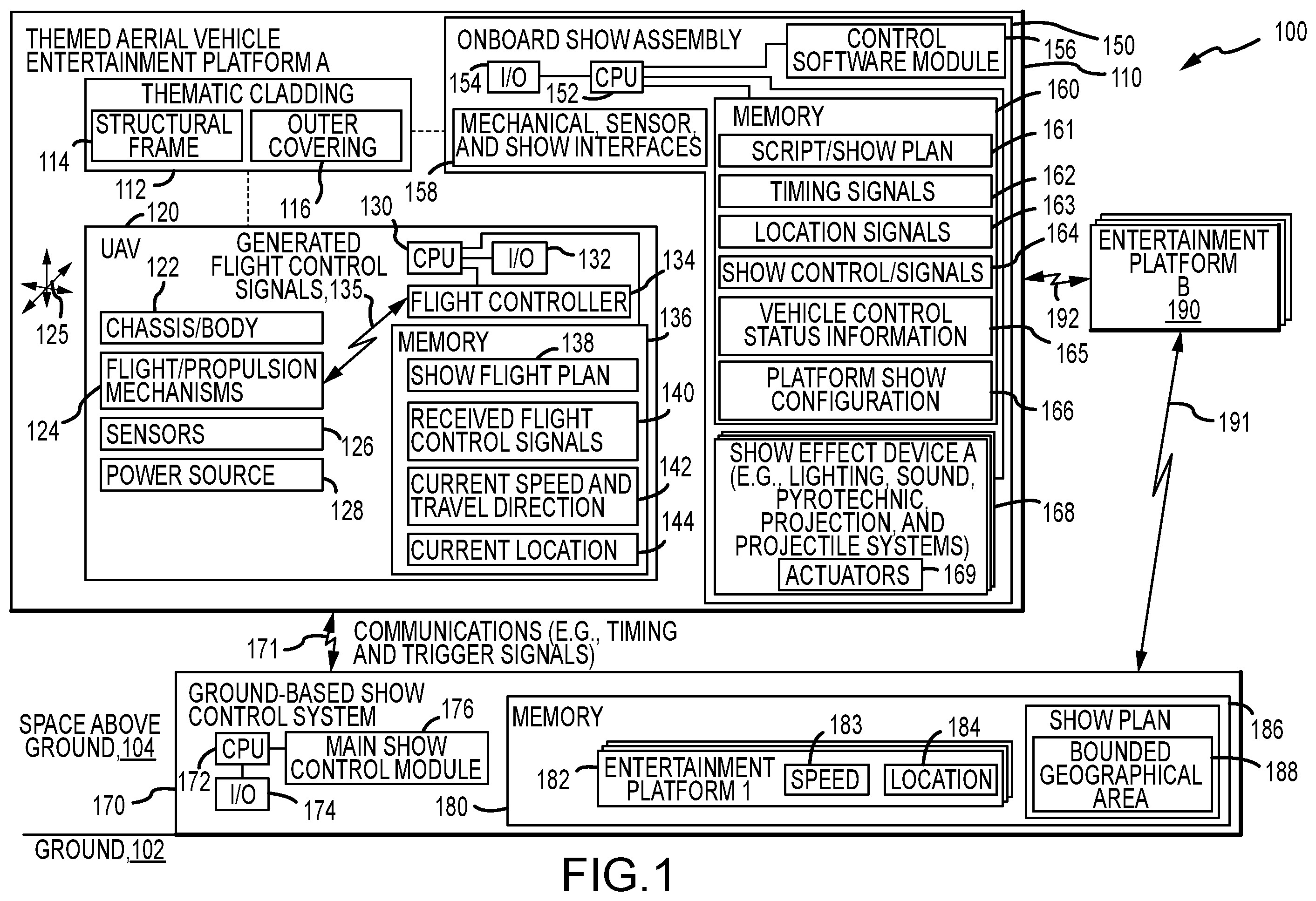
Figure 1 of the granted 2025 patent, U.S. Patent 12,230,153, the system diagram. The box near the top left reading THEMATIC CLADDING, with STRUCTURAL FRAME and OUTER COVERING inside it, is exactly the element the new claims stop requiring. It stays in the drawings and the written description, because a continuation carries the parent's disclosure over and cannot add new matter to it. Credit: U.S. Patent and Trademark Office / Disney Enterprises, Inc.
There is one more broadening hiding in the middle of the set. Independent claim 10 does not say "UAV" at all; it claims an "aerial platform." Claim 15 then narrows it back down, adding that "the aerial platform is an unmanned aerial vehicle." When being a drone is a dependent claim rather than a requirement, the independent claim above it is reaching for something wider than drones.
One correction to the reporting
WDWMagic, which also covered this filing, got the substance right: its report has Disney "dropping the requirement for a themed outer shell" and focusing instead on "the onboard real-time script-switching technology," which is the same read we came to. One sentence in it goes further than the document supports. WDWMagic wrote that "The themed shell now only appears in a narrower, secondary claim."
That is not what the document says. We read all 20 claims of US 2026/0268782 A1 in the patent office's own publication and again in the full text on FreePatentsOnline. The words "cladding," "thematic" and "themed" appear zero times anywhere in the claim set, narrow or otherwise. The themed shell survives only in the abstract, the drawings and the written description. Those parts can be used to interpret claim language, and they preserve the option of claiming the shell again in a future filing, but they are not themselves the scope of what Disney owns. The claims are.
What this does and does not mean
Worth keeping the temperature down on two points.
First, this is a published application, not a granted patent. Claims get amended, narrowed and sometimes cancelled during examination, and the set published Thursday is a starting position rather than a result.
Second, a continuation like this is a routine legal move, not a change of plan. A continuation has to be filed while the parent application is still pending, so filing on January 13, 2025, roughly five weeks before the parent issued, is what keeps the family alive and leaves room for a second, broader set of claims drawn on the same 2019 description. A patent lawyer would offer a second reading as well: a claim with no cladding limitation is simply easier to assert against somebody else's drone show, whether or not Disney ever flies one without a shell.
What it does show is a change in what Disney is asking to own. The claims that issued in 2025 covered a drone wearing a ship. The claims filed in January 2025 cover the drone that knows what to do when the show goes sideways. Worth noting that the 2019 description already contained both. Its summary section introduces the thematic cladding with "may include," and its opening paragraphs frame the dynamic show adjustment that the script switching performs as the inventors' own recognition. So this is a shift in claim strategy, which is not the same thing as a shift in what the company values.
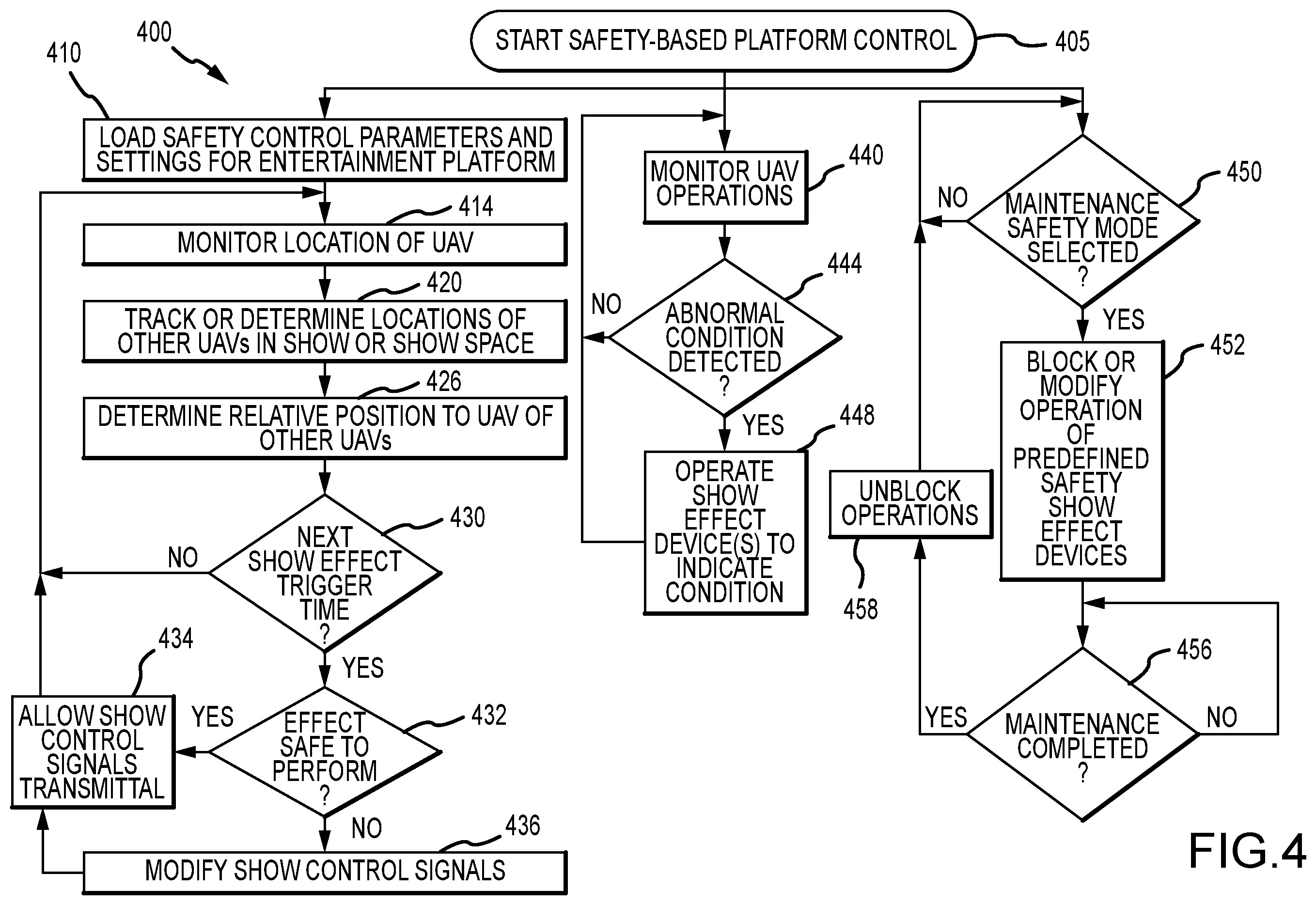
Figure 4 of that same granted 2025 patent, the safety control flowchart. Before each cue fires, the diamond labeled EFFECT SAFE TO PERFORM? sends the drone either to ALLOW SHOW CONTROL SIGNALS TRANSMITTAL or to MODIFY SHOW CONTROL SIGNALS. A separate branch handles a maintenance mode that blocks or modifies operation of predefined safety show effect devices until the work is finished. Credit: U.S. Patent and Trademark Office / Disney Enterprises, Inc.
Disney has not tied any announced attraction, show or product to this specific filing, and a patent application is not a promise that anything gets built.
The idea is not hypothetical, though. In December 2019, the same year the original application was filed, Boeing partnered with Walt Disney Imagineering Research & Development to mount X-wing "body shells" on two of Boeing's Cargo Air Vehicles and fly them over a Star Wars: Galaxy's Edge opening event at Walt Disney World. The Smithsonian's National Air and Space Museum, which has since put one of the aircraft on display at its Steven F. Udvar-Hazy Center, says ultraviolet spotlights lit them "so that only the X-wing frame was visible." That is thematic cladding, already flown.
Sources
- U.S. Patent and Trademark Office, published application US 2026/0268782 A1
- FreePatentsOnline, full text of US 2026/0268782 A1 (claims and cross reference to the parent application)
- Google Patents, U.S. Patent 12,230,153 B2 (the granted 2025 parent, its 17 claims and its figures)
- WDWMagic, Disney Widens Patent Claims for Its Drone Show System
- Smithsonian, National Air and Space Museum Welcomes Star Wars X-wing Outfitted Boeing CV2 Cargo Air Vehicle
Image credits: All three figures are from U.S. Patent 12,230,153 B2, whose drawings the new application continues. Patent drawings published by the U.S. Patent and Trademark Office are generally free of copyright restrictions. Credit: U.S. Patent and Trademark Office / Disney Enterprises, Inc. Figures 1 and 4 have been rotated upright from the printed page orientation.