Universal Filed a Patent Application for Projecting Images Onto a Costume While It Flows, With More Trackers on a Dress Hem Than on a Fitted Torso
Projection mapping tends to work best on something that holds still. Castles work. Buildings work. A dress swishing around an animated figure's ankles does not. The filing frames the gap slightly differently, saying projection mapping onto animated figures has "traditionally" delivered a "canned or fixed set of images," and that "advances may be made to provide improved immersive experiences for the guests."
Universal has filed for the opposite.
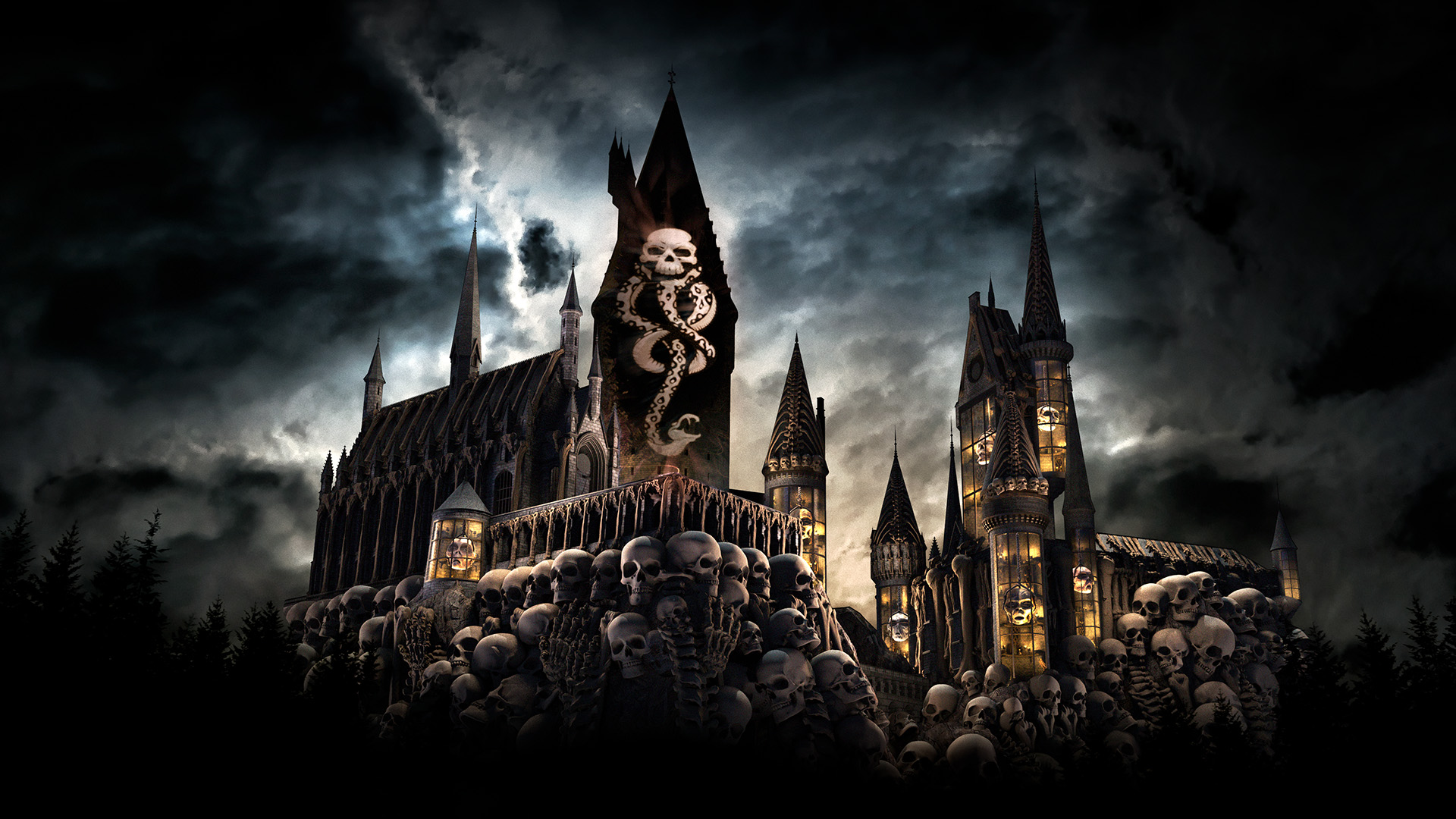
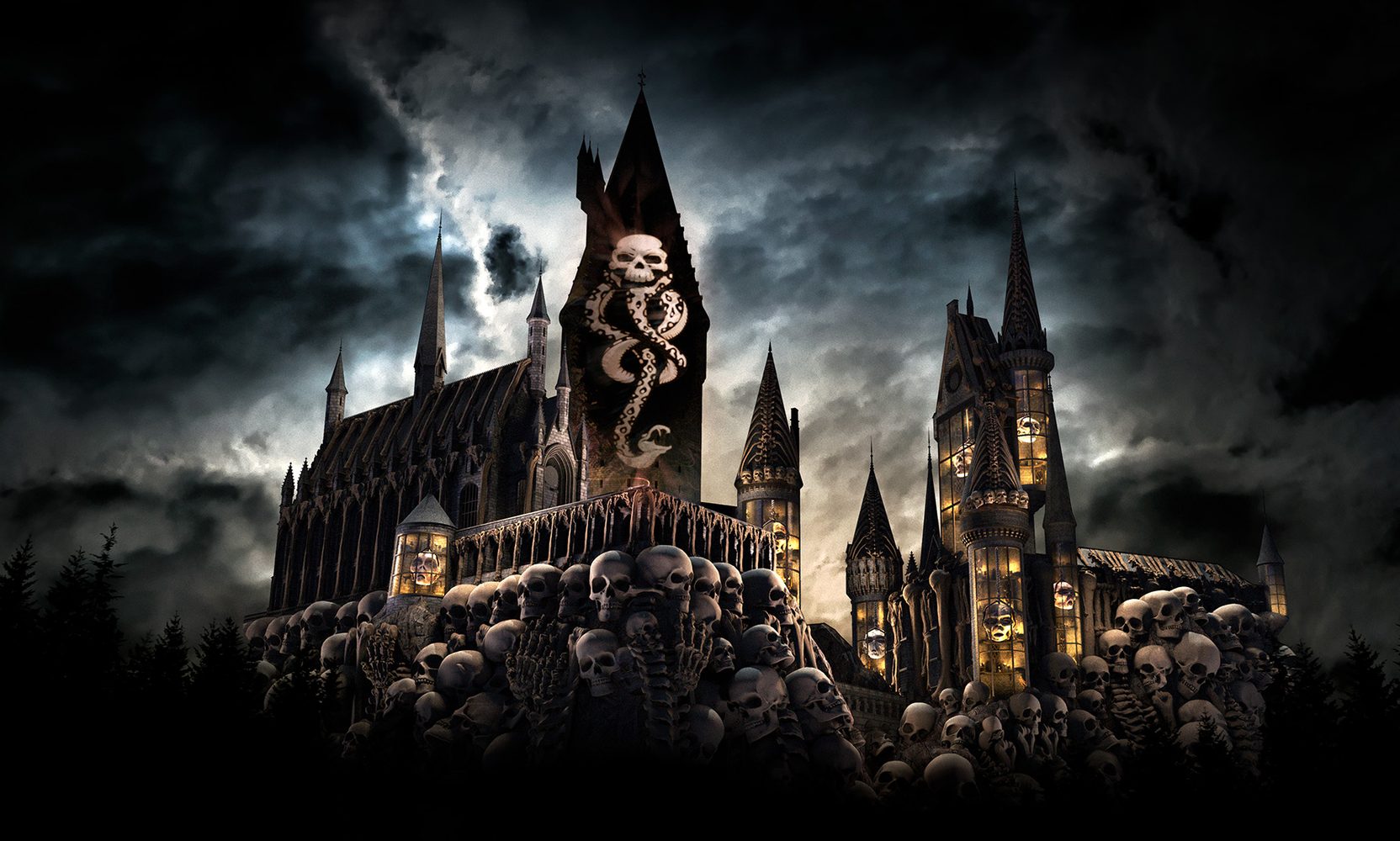
Dark Arts at Hogwarts Castle, a projection mapping show at Universal Islands of Adventure. The castle, crucially, does not move. Image: Universal Orlando Resort
What the filing says
The document is United States Patent Application 20260261632, titled "SYSTEMS AND METHODS FOR PROJECTION MAPPING ONTO FLOWABLE TEXTILES IN AN ENTERTAINMENT ENVIRONMENT." It is assigned to Universal City Studios LLC, carries application number 19/555399, and published on September 3, 2026 after being filed on March 3, 2026. It claims priority to two earlier provisional applications of the same name, filed March 3, 2025 and February 23, 2026.
The abstract is drier than the idea deserves:
An attraction system may include a show element with a body, a textile that covers at least a portion of the body, and multiple trackers coupled to the textile. The attraction system also includes a processing system with one or more processors and memory storing instructions executable by the processing system to cause the processing system to process tracking data to determine respective positions of the multiple trackers, and instruct a projector to project image data onto the textile based on the respective positions of the multiple trackers.
In plainer terms: put trackers on the fabric, watch where the fabric actually is, and steer the projector to follow it. The filing says the point is to "dynamically change appearance of the textile to create a costume-changing illusion."
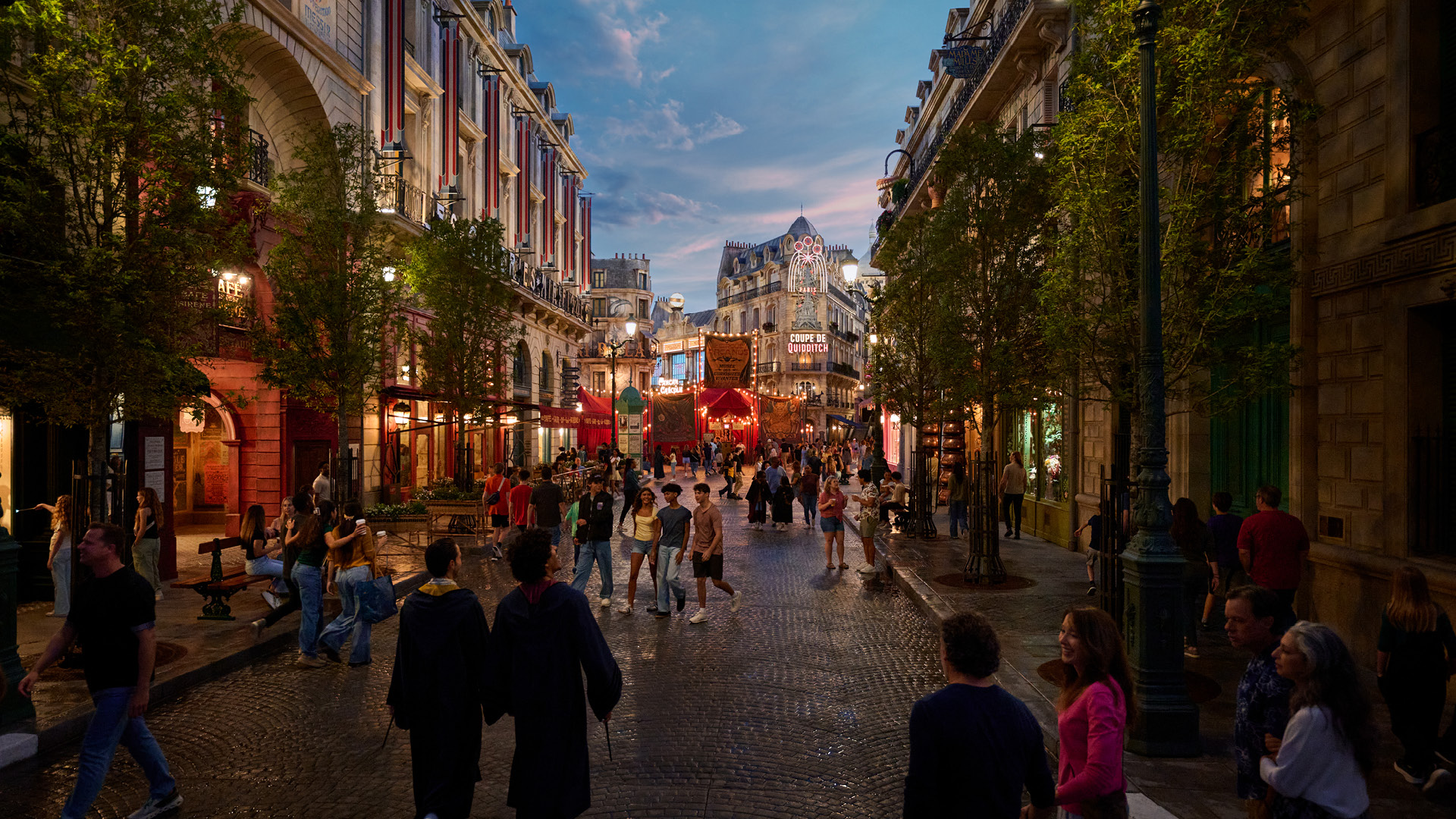
Flowing robes and hanging fabric in the Ministry of Magic land at Epic Universe. The filing is about projecting onto material that behaves like this. Image: Universal Orlando Resort
The detail that gives it away
The best passage is about where you put the trackers. The filing offers example spacings of "less than or equal to about 5, 10, 15, 20, 25, 30 centimeters apart," so 5 centimeters is the tightest figure it names rather than a stated minimum. It also sketches two ways to place them: clustering trackers near an animated figure's movable joints, "such as shoulder joints," or varying the density by how freely the cloth moves, with more trackers near "a bottom portion of a dress" and fewer near "a fitted torso portion of the dress." Figure 3 illustrates that second arrangement.
That reads less like a whiteboard sketch than like something worked out against real fabric, though nothing in the filing says whether any of it has been built.
The system is also written to predict where the fabric is about to be, not just where it is. The filing lists additional inputs the processor can take into account, including the current and planned position of a ride vehicle, other show effects such as wind and haptics, and even the building's heating, ventilation and air conditioning system. If a fan is about to blow, the projector can know.
Ride vehicles come up nearly 40 times in the description, which is a hint, though only a hint, that a dark ride is one of the settings the authors had in mind. The filing itself stays deliberately broad, listing amusement parks, theatres, sports arenas, museums, hotels and restaurants among possible environments, and rides, haunted houses, escape rooms, mazes and performance stages among possible attractions. Ride vehicles also appear in only two dependent claims, never in an independent one.
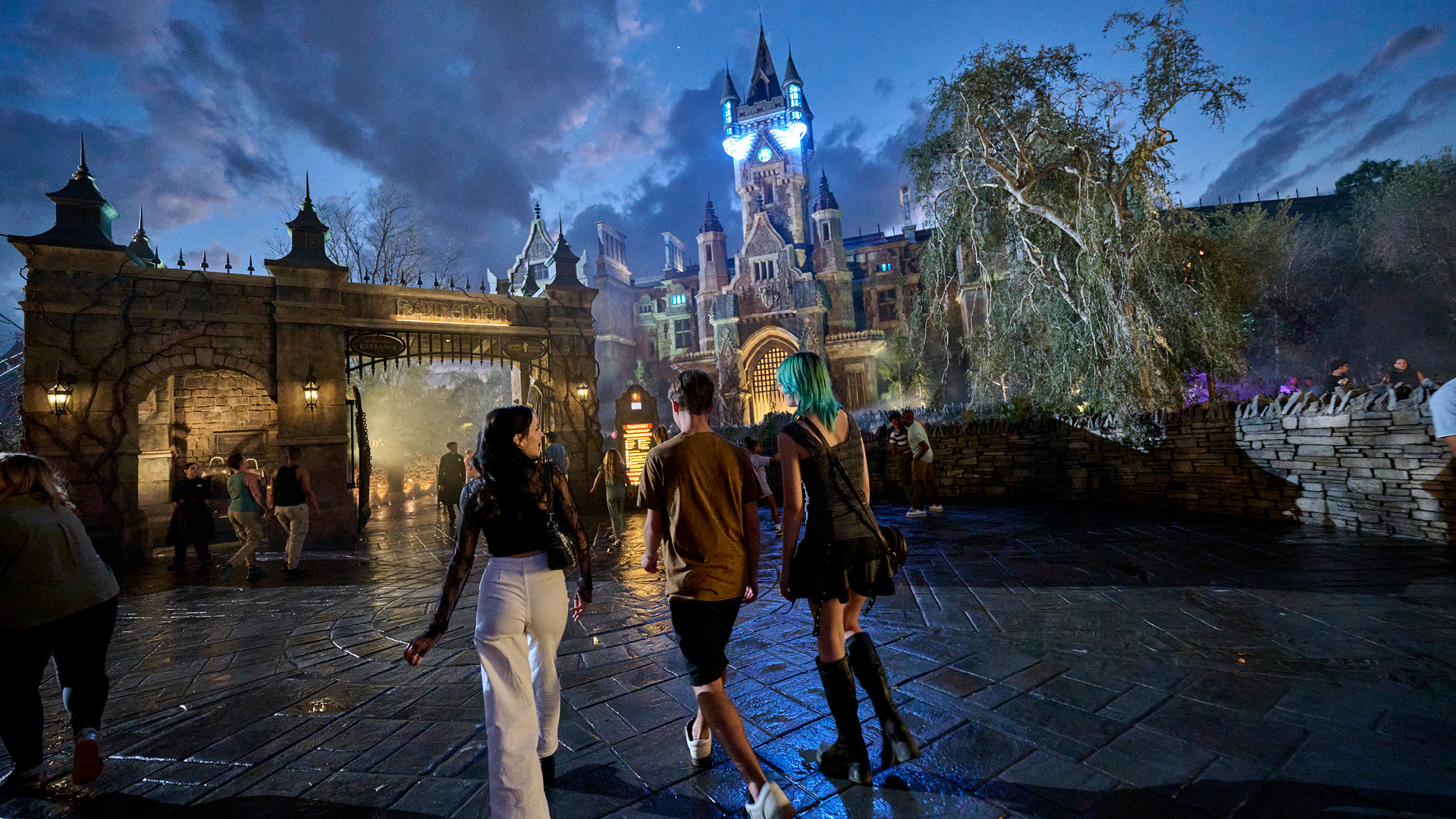
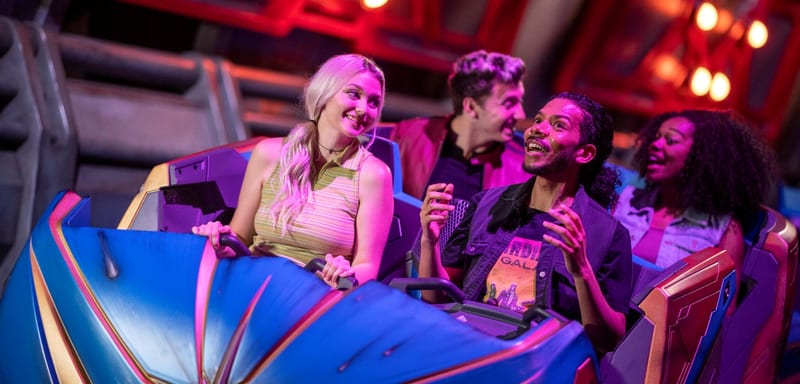
Dark Universe at Epic Universe. Universal has not tied the filing to this or any other land. Image: Universal Orlando Resort
The usual caveat, and it matters here
A published application is not an announcement. Universal has not publicly connected this filing to any attraction, announced or otherwise, and theme park companies routinely file far more than they build. Treat it as evidence of what Universal's engineers are interested in, not as a ride.
It is also worth noting that this was not the only Universal filing to publish that day. Application 20260257816, "DRONE ATTRACTION SYSTEM AND METHOD," published on September 3 as well. Theme Park Insider surfaced both of them, alongside a Disney robotics filing, in a roundup on September 4.
Sources
- United States Patent Application 20260261632, "SYSTEMS AND METHODS FOR PROJECTION MAPPING ONTO FLOWABLE TEXTILES IN AN ENTERTAINMENT ENVIRONMENT," via FreePatentsOnline
- United States Patent Application 20260257816, "DRONE ATTRACTION SYSTEM AND METHOD," via FreePatentsOnline
- Theme Park Insider, Robert Niles, September 4, 2026
Image credits: All images Universal Orlando Resort.