 News
News Robin Williams, Time Travel, and Nine Screens: Remembering The Timekeeper 20 Years Later
If you visited Magic Kingdom's Tomorrowland anytime between 1994 and the early 2000s, there's a good chance you wandered into a circular theater, stood shoulder-to-shoulder with your family in front of nine towering screens, and let Robin Williams take you on a time-traveling joyride through history.
Twenty years ago — on February 26, 2006 — The Timekeeper closed its doors for the last time. What replaced it (Monsters, Inc. Laugh Floor) gets a few chuckles. What it replaced in the hearts of a generation of Disney fans? Nothing ever has.
This is the story of one of Tomorrowland's most ambitious, most underappreciated, and most missed attractions.
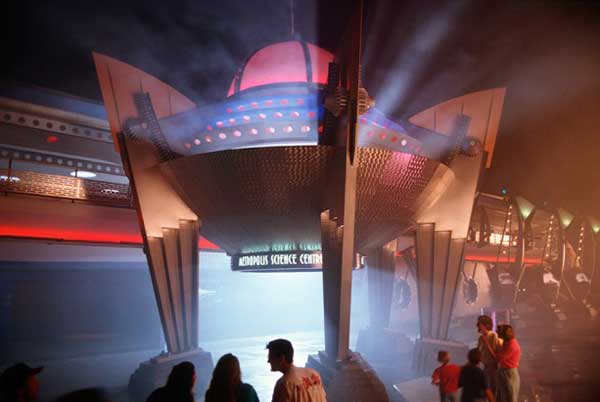
The Metropolis Science Center — home of The Timekeeper — in Tomorrowland at Magic Kingdom. Photo credit: Tomorrow Society / Disney
A New Tomorrowland Is Born
To understand The Timekeeper, you have to understand the moment it arrived. In 1994, Magic Kingdom's Tomorrowland underwent a massive reinvention. Gone was the sleek, sterile vision of the future. In its place came a retro-futuristic aesthetic inspired by the optimistic sci-fi of Jules Verne and H.G. Wells — all copper gears, riveted metal, and the romantic idea that the future would be wonderful.
The old Circle-Vision theater — which had previously housed American Journeys — was rechristened the Metropolis Science Center and became home to The Timekeeper. It was, officially, the first Circle-Vision 360° attraction to feature a full narrative story, complete with Audio-Animatronics, celebrity voice talent, and integrated special effects. The show was adapted from Le Visionarium, which had premiered at Disneyland Paris in 1992 and later opened at Tokyo Disneyland in 1993. But the Magic Kingdom version was rebuilt from the ground up with an English-language cast and new footage tailored for American audiences.
Before the Show: A Queue Worth Remembering
The experience began long before you entered the theater, and this is something that today's Disney fans especially mourn — the queue itself was an attraction.
The wall separating the building from the Tomorrowland walkway was a stunning stained-glass mural featuring 22 famous inventors and visionaries. Step inside, and you entered what felt like a mad scientist's workshop. The pre-show area was packed with lovingly crafted props:
A 20-foot model of Da Vinci's Heliocentric Solar System, slowly rotating overhead
A detailed model of the Nautilus from Jules Verne's Twenty Thousand Leagues Under the Sea
The Albatross from Verne's The Clipper of the Clouds
A real 1920s film projector from Walt Disney Pictures
An actual copy of Verne's novel Twenty Thousand Leagues Under the Sea
Pillars filled with bubbling water, giving the room a futuristic laboratory feel
Television screens counted down to your departure, and a robotic voice introduced the mission. You weren't just waiting in line — you were being briefed for time travel.
The Timekeeper attraction in Tomorrowland. Photo credit: Extinct Disney
Meet Your Hosts: A Robot and His Camera Drone
The stars of the show were two Audio-Animatronic characters who greeted you inside the theater:
The Timekeeper — voiced by Robin Williams — was a manic, fast-talking robot inventor with wild eyes and boundless enthusiasm for science. He was the self-proclaimed genius behind the time machine you were about to experience. Williams brought exactly the energy you'd expect: rapid-fire jokes, vocal impressions, and an infectious excitement that made the whole room feel electric.
9-Eye — voiced by Rhea Perlman (Carla from Cheers) — was Timekeeper's loyal but long-suffering camera drone. She was literally a flying robot equipped with nine cameras, one for each of the Circle-Vision screens surrounding the audience. Where Timekeeper was chaos, 9-Eye was exasperated competence. Their dynamic was comedy gold.

The Timekeeper Audio-Animatronic character inside the Circle-Vision theater. Photo credit: Extinct Disney
The Robin Williams Backstory
Here's a piece of Disney history that makes The Timekeeper even more fascinating. The Timekeeper character was literally designed with Robin Williams in mind — Imagineers wrote the role specifically for him. However, the audio heard in the attraction was compiled from test recordings rather than a formal recording session. This was due to Williams' famous falling out with Disney over the studio's breach of contract regarding how his Genie performance was used to market Aladdin. Despite the complicated relationship, Williams' voice work in The Timekeeper was unmistakably brilliant — energetic, improvised, and perfectly suited to the character.
The Show: A 360-Degree Trip Through Time
This was a standing-room-only experience. There were no seats — you stood in the center of a circular theater surrounded by nine massive screens while the story unfolded all around you. It was immersive in a way that modern attractions with their individual ride vehicles sometimes struggle to match. You weren't watching the story; you were inside it.
The plot kicked off when 9-Eye was accidentally sent back to the Jurassic Period, where she narrowly avoided becoming a dinosaur's lunch. After Timekeeper recalibrated the machine, the real adventure began — a whirlwind tour through human history:
1450: Johann Gutenberg's printing press workshop, which quickly veered into a Scottish Highland battle
The Renaissance: Leonardo da Vinci's workshop, where the great inventor tested his flying machines (Da Vinci was played by Franco Nero)
18th Century Vienna: A young Mozart performing for Louis XV (played by Jean Rochefort)
1878 Paris: The construction of the Eiffel Tower and the Paris Exposition
1900 Universal Exposition: A pivotal meeting between Jules Verne (Michel Piccoli) and H.G. Wells (Jeremy Irons) — two giants of science fiction, brought together by time travel
The climax came when Jules Verne was accidentally pulled into the present day and experienced the modern world — trains, race cars, bobsleds, helicopters, and a breathtaking flyover of New York City. The American version featured "Motownphilly" by Boyz II Men during the modern-day montage, replacing European aerial footage from the original French version. Verne was then returned to 1900, presenting 9-Eye with a flower in a genuinely sweet moment, as H.G. Wells looked on knowingly.

The Timekeeper Audio-Animatronic character inside the Circle-Vision theater. Photo credit: Extinct Disney
The finale sent an audience family to Paris in the year 2189, where Verne and Wells appeared in a flying ship — a beautiful bookend that tied the past, present, and future together.
Why It Mattered: The Nostalgia Factor
For kids who grew up visiting Walt Disney World in the '90s, The Timekeeper occupies a very specific place in the memory. It wasn't a thrill ride. It wasn't a dark ride. It was something harder to categorize and, in many ways, harder to replace: a theatrical experience that made you feel genuinely transported.
The Circle-Vision format was the key. When 9-Eye flew over the Eiffel Tower under construction, you looked up and felt the height. When she careened through a Scottish battle, warriors charged at you from every direction. When Jules Verne experienced a modern-day bobsled run, your stomach dropped even though you were standing perfectly still.
And then there was Robin Williams. In the mid-'90s, Williams was arguably the most beloved entertainer on the planet. Hearing his voice crack jokes and riff inside a Disney attraction felt like a special gift — like he was performing just for you and the hundred other people in that room.

A look inside The Timekeeper experience. Photo credit: Extinct Disney
The Slow Goodbye
The Timekeeper didn't die suddenly. It faded away gradually, which somehow makes it sadder.
On April 29, 2001, the attraction shifted to seasonal operation — open only during peak periods like holidays and summer. Then came September 11, 2001. The show's climactic modern-day sequence included several seconds of footage featuring the World Trade Center towers in the New York City skyline. After the attacks, this footage became impossible to show without fundamentally changing the emotional tone of the experience.
The attraction operated sporadically after that, with its final performance on December 31, 2005. Disney officially announced the permanent closure on February 26, 2006. The Timekeeper was gone — not with a farewell celebration, but with a quiet sign on the door.

A look inside The Timekeeper experience. Photo credit: Extinct Disney
What Came After
In April 2007, the former Timekeeper theater reopened as Monsters, Inc. Laugh Floor — an interactive comedy show where animated monsters tell jokes and interact with the audience via live cameras. It's a perfectly fine attraction. It gets laughs. Kids enjoy it.
But for those who remember standing in that dark circular room, watching Robin Williams' robot twist and gesture while nine screens transported you from prehistoric jungles to the streets of Paris to the skies above New York — Laugh Floor has never quite filled the void.

The abandoned backstage area of The Timekeeper — a haunting reminder of what once was. Photo credit: Extinct Disney
A Lost Legend
The Timekeeper represented something Disney used to do exceptionally well: create attractions that were ambitious, educational, and emotionally resonant without being tied to a movie franchise. It celebrated human ingenuity. It made science fiction feel warm and accessible. It took Jules Verne's optimistic vision of the future and wrapped it in Robin Williams' comedic genius.
Twenty years later, the Circle-Vision screens are gone. The stained-glass inventors have been removed. The Nautilus model and Da Vinci's solar system are memories. But if you close your eyes and listen carefully, you can almost hear Robin Williams' voice echoing through Tomorrowland: "Welcome to the Metropolis Science Center! I am the Timekeeper!"
And for just a moment, you're twelve years old again, standing in the dark, surrounded by nine screens, traveling through time.

Photo credit: Extinct Disney
Sources: D23 - The Official Disney Fan Club, Extinct Disney, Walt Dated World, Tomorrow Society, Park Lore, WDW Magic. Photos credited individually throughout the article.