Universal Patent Filing Describes Rides That Switch Themselves Into a Backup Show When a Prop Fails
Regular park-goers know the B mode. An animatronic stops moving, a projection goes dark, and the attraction carries on in a lesser version of itself. A new Universal patent filing describes a ride that makes that call on its own, while it is running.
The U.S. Patent and Trademark Office published the application, US 2026/0364476 A1, on November 19. It is titled "Systems and Methods for Operating an Amusement Park System," the applicant is Universal City Studios LLC, and the listed inventor is Patrick John Goergen of Orlando. Theme Park Insider flagged it the same day, describing it as Universal's plan "for a more robust system for switching theme park attractions into B mode."
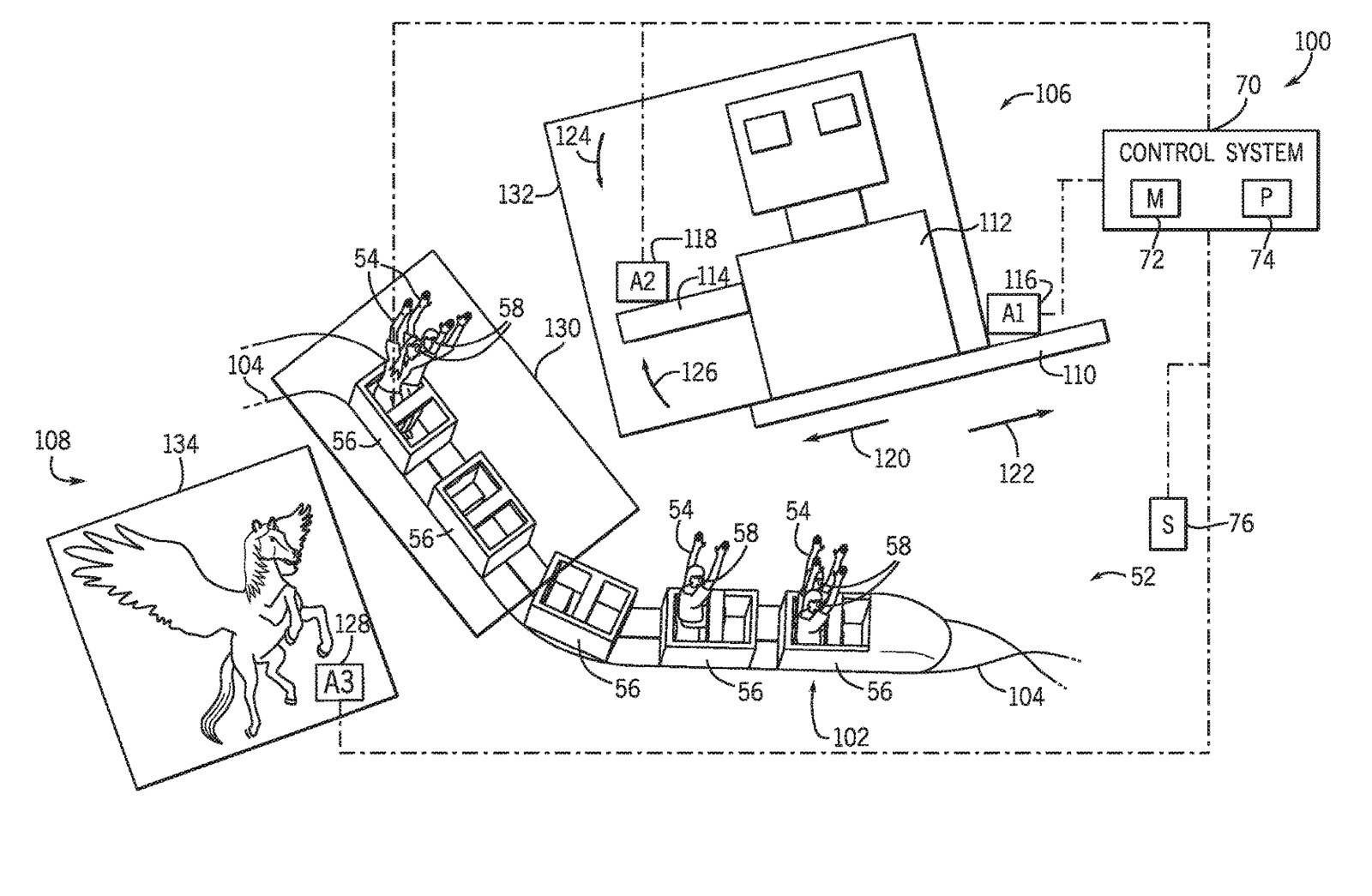
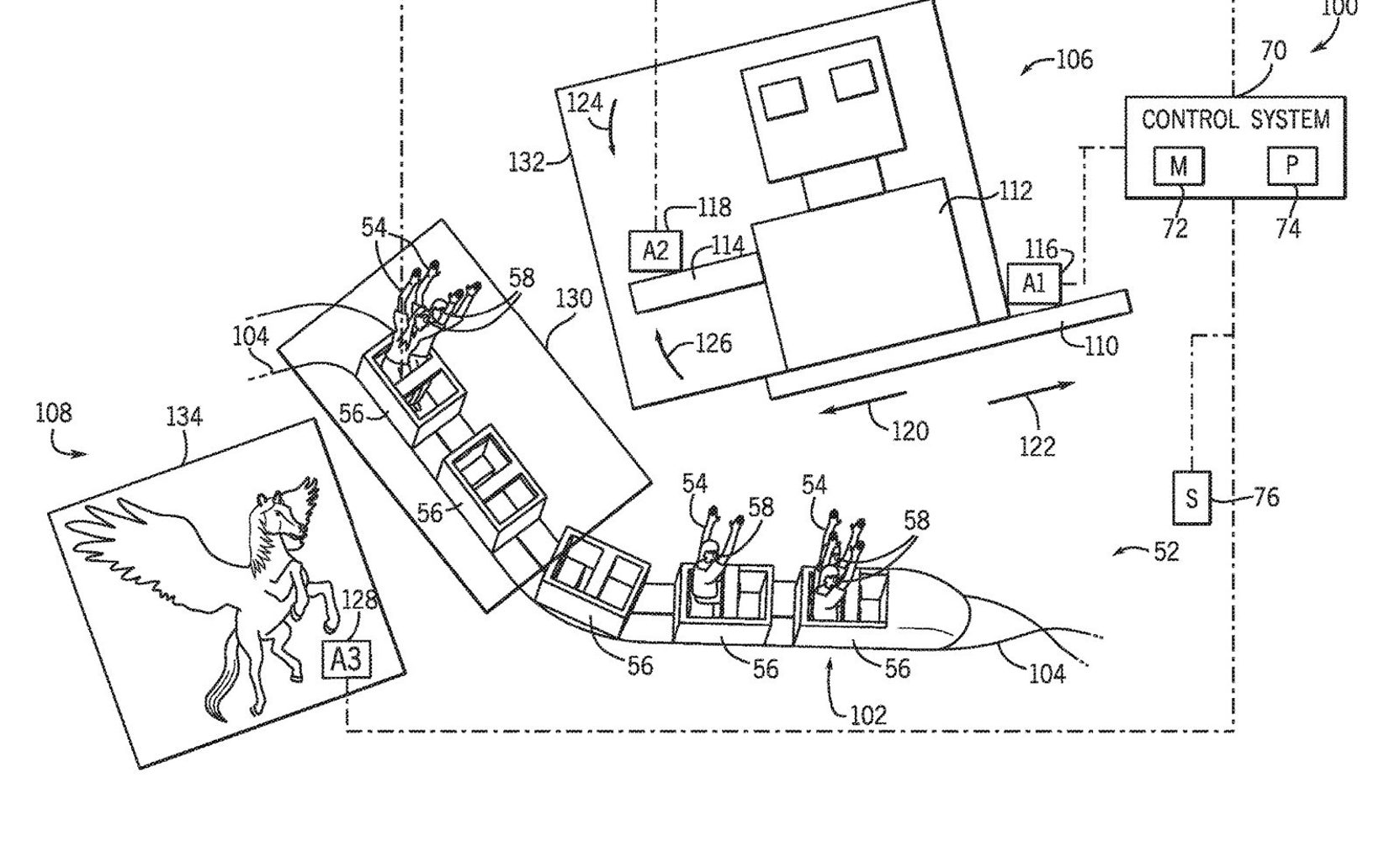
Figure 2 from the application: coaster riders in goggles pass two animated figures, whose actuators and a sensor link to a control system. Image: USPTO / Universal City Studios LLC
How it works, in plain English
The control system runs the attraction in a "primary mode" and keeps reading sensors while it does. Each reading is compared with an acceptable range. If one falls outside it, the abstract says the controller will "transition operation of the amusement park attraction system from the primary mode to a secondary mode."
There is not just one fallback. The filing says the system may move the ride "to one of a plurality of secondary modes" and pick which one based on what the sensors are reporting. The ranges themselves can shift too, set differently for each mode or even each ride cycle.
The point, in the filing's own words, is to keep giving riders a good show "instead of, for example, suspending operation" of the attraction.
What a secondary mode could look like
The application walks through examples built around Figure 2, a coaster whose riders wear "extended reality devices" shown as goggles, passing two animated figures. Among the fallbacks it describes:
- Back off a figure that gets too close. If a figure's arm or body and the ride vehicles get too close to each other, the system can reduce or stop the figure's motion, or send the vehicles along a different part of the path, or move the path itself.
- Let a second figure cover for the first. If one figure is not doing its job, the system can reposition the other one so it provides "similar show effects" in its place.
- Fill the gap with effects. The system can add lighting, fog, imagery or sound, and can have the riders' goggles show imagery that appears where the faulty figure would normally be.
- Work repairs into the show. If a reading points to a maintenance job, a technician may be visible to riders while the ride keeps running, and the goggles can show imagery that appears to interact with that technician, so the work looks like part of the experience.
It is not only about coasters. The application says the same approach could apply to a motion simulator, an attraction with no ride vehicle at all, or other kinds of props such as displays, projectors, fog machines and speakers.
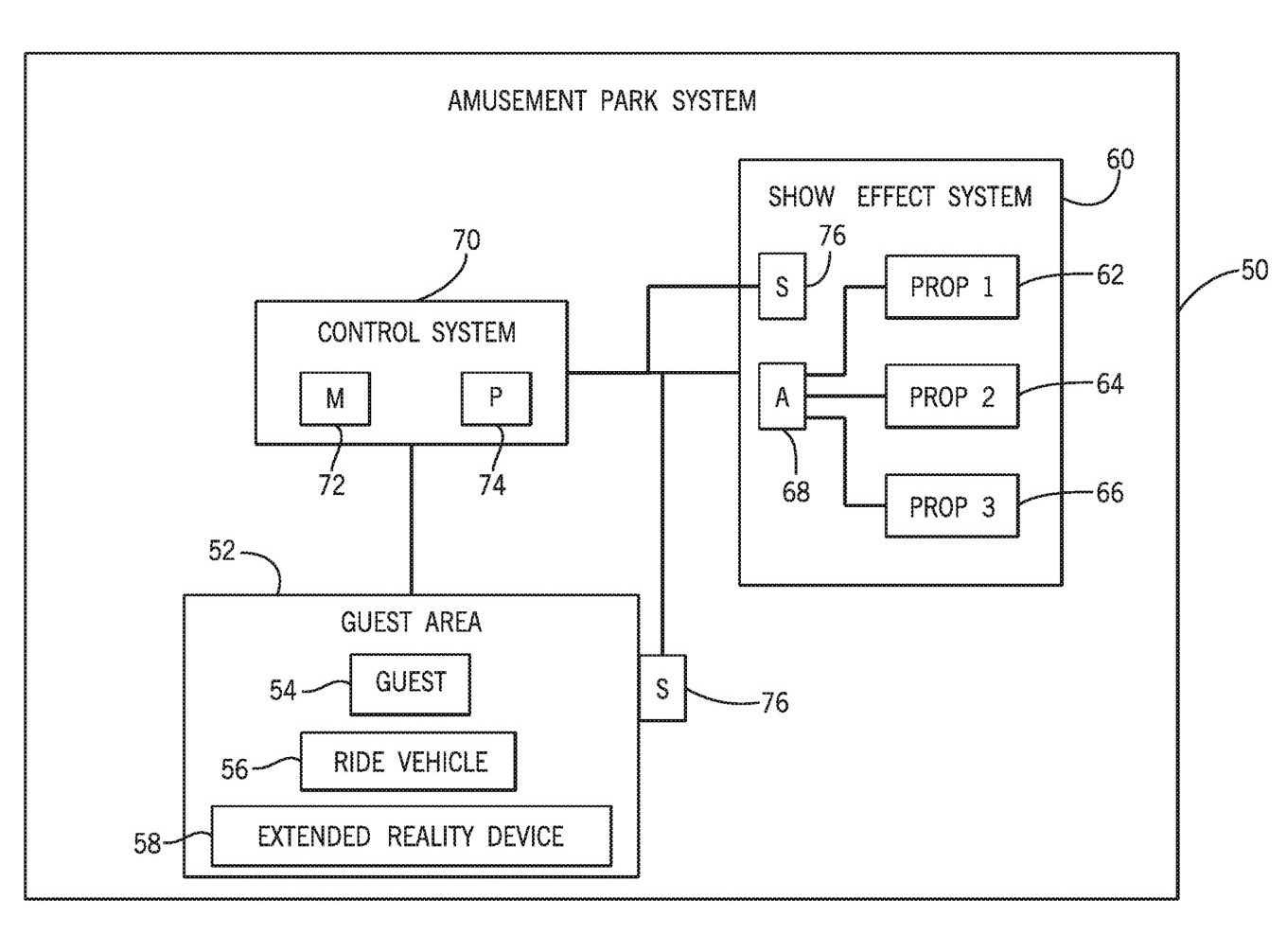
Figure 1: the control system sits between the props and the guest area, with sensors (S) feeding it. Image: USPTO / Universal City Studios LLC
A lot of sensors
The list of what could feed the system is long: cameras, infrared and LIDAR, proximity sensors, gyroscopes and GPS, accelerometers, load cells, strain gauges, pressure sensors, and current or voltage sensors.
Not brand new, and not a ride announcement
This publication is a continuation. Its front page says it continues application No. 17/959,647, filed October 4, 2022, "now Pat. No. 12,722,093," with a provisional application dating to August 3, 2022. So Universal already holds one patent from this same disclosure, and it filed this follow-up on July 27, 2026, to pursue further claims from it.
As with every patent we cover, a filing is not a construction plan. The application names no park and no attraction, and Universal has not said where, or whether, it will use any of this.
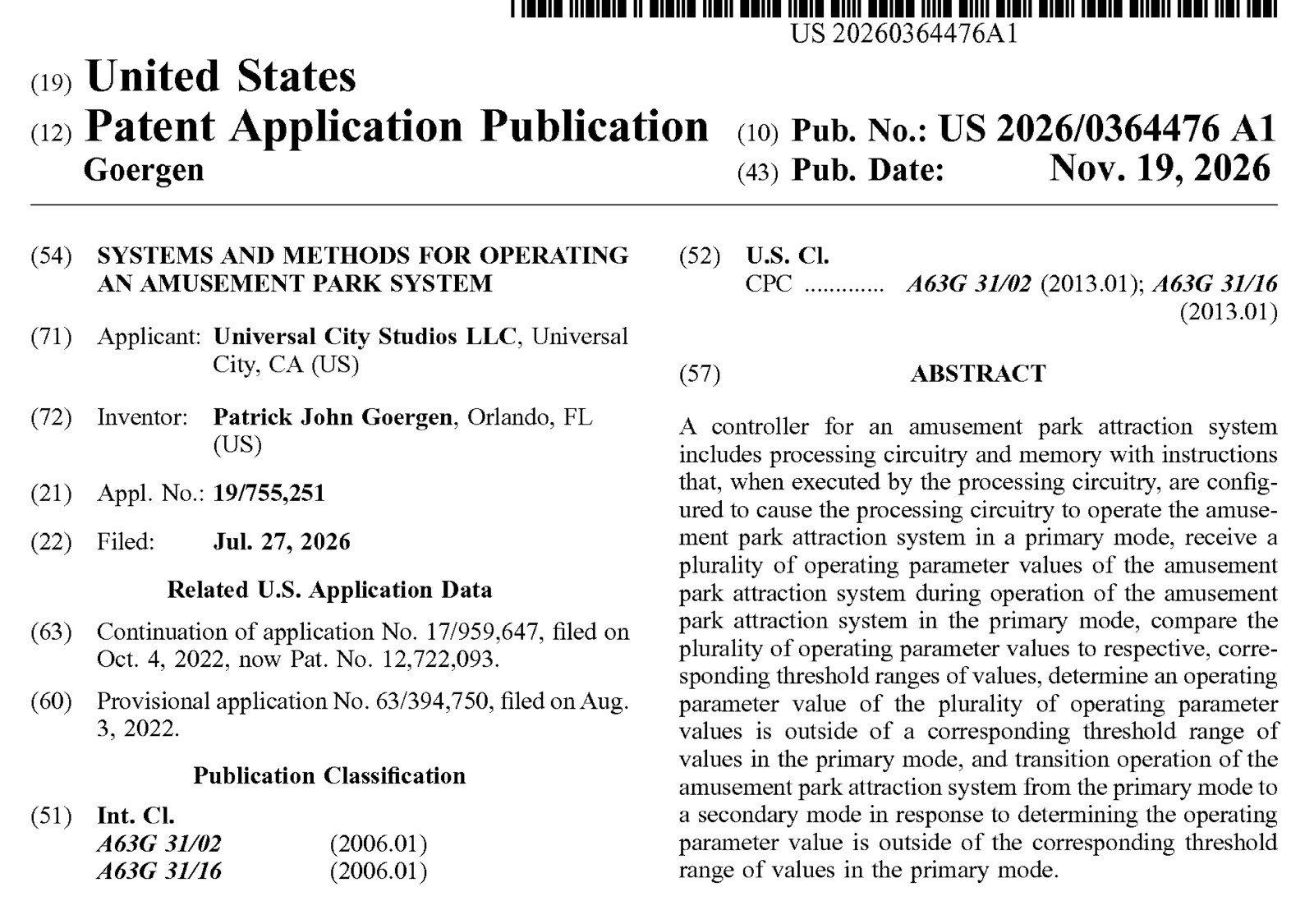
The front page of US 2026/0364476 A1, published November 19, 2026. Image: USPTO / Universal City Studios LLC
Which Universal ride would you most want running this kind of smart backup mode instead of closing for a breakdown? Tell us below.
Sources
- USPTO, US 2026/0364476 A1, "Systems and Methods for Operating an Amusement Park System" (PDF)
- Theme Park Insider, "Universal files plan for self-fixing theme park attraction"
Image credits: USPTO / Universal City Studios LLC (all patent drawings and the front page).