
Disney Patent Filing Would Train AI to Filter Out Screaming Guests and Listen for Ride Equipment That Sounds Wrong
Every coaster comes with a soundtrack of screaming guests. A new Disney patent application treats all of that noise as something to throw away, so a computer can hear what the ride itself is doing.
The application, "Techniques for Detecting Anomalies in Audio Recordings for Predictive Maintenance," was published by the U.S. Patent and Trademark Office on September 24, 2026, as US 2026/0287420. Disney Enterprises filed it on March 21, 2025. Blog Mickey and Laughing Place wrote it up on Sunday, with Laughing Place pointing readers to the patent tracker Patentlyze.
The problem Disney describes
The filing is blunt about the human way of doing this. It says one approach at amusement park attractions "is for human operators to listen for unusual sounds being made by the equipment." The drawback, in Disney's words, is that "operators may not hear unusual sounds at certain locations within an amusement park attraction," and "may not always understand which sounds are unusual."
Automating the job is hard for a very theme park reason. Attractions, the application says, "are oftentimes in open air environments crowded with loud guests," which makes the audio "typically too noisy for conventional anomaly detection systems" to pick out a bad sound from things like guests' voices.
Two AI models and a fuzzy wind filter
The system starts with what the filing calls scientific microphones, pointed at a specific piece of equipment. Its list of possible targets includes a ride, a mechanical system like a track or hydraulic system, and an "animatronic, speaker system, etc., or a portion thereof (e.g., a ride switch, track switch, actuator, motor, etc.)." The microphones can be mounted apart from the equipment or on top of it, with a ride vehicle given as the example.
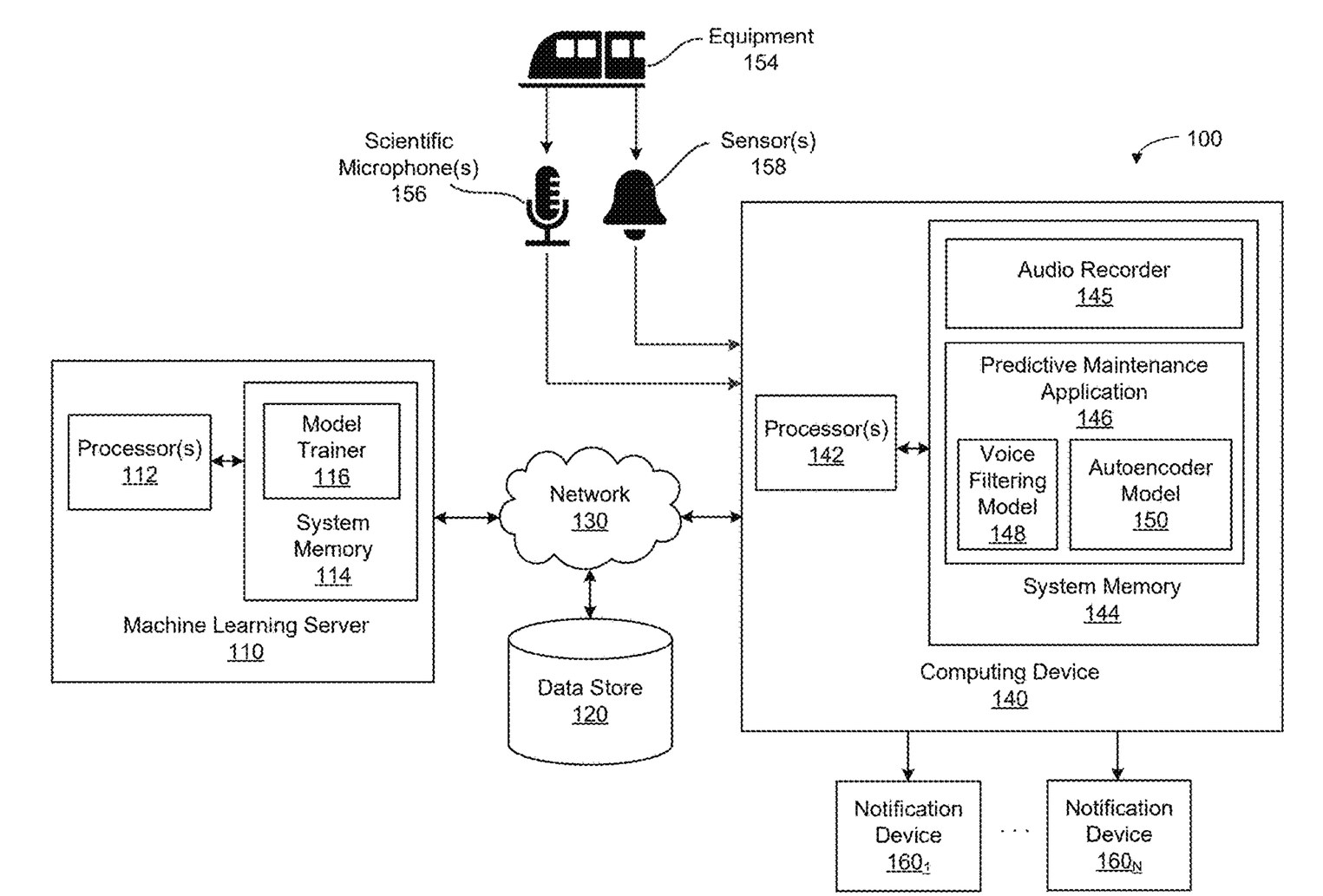
FIG. 1 from the application: equipment, a microphone and a sensor feed a voice filtering model and an autoencoder, which send alerts to notification devices. Image: USPTO / Disney Enterprises, US 2026/0287420
Each microphone can sit inside a wind filter. The filing describes a cylinder with "fur or another fuzzy material" fixed to the outside to block wind noise, and a stabilizer inside that holds the microphone in place.
A sensor tells the system when the equipment is actually working. In the application's running example, a microphone aimed at a track switch captures audio when a sensor says the switch is moving or has moved. (Another version records constantly and slices out those moments later.) Each of those recordings "could last a few seconds (e.g., 5-8 seconds)."
Then the two models go to work:
- The voice filter. It is trained on recordings of the equipment running normally, layered with recordings of people. The filing says those people sounds include "screaming and other emotive voices, speaking voices, laughing voices, etc." and can come from "a publicly available library of human voice recordings." The trained model separates the voices out and keeps the machine sound.
- The anomaly detector. An autoencoder learns what the voice-filtered equipment normally sounds like and tries to rebuild each new recording. The difference between the voice-filtered recording and its rebuild is the "reconstruction error," and an alert goes out "when the reconstruction errors over a period of time satisfy a threshold."
The same approach could train other filters, too. The application mentions models that could strip out music, animal noises, or "weather noises, such as rain, thunder, wind, etc."
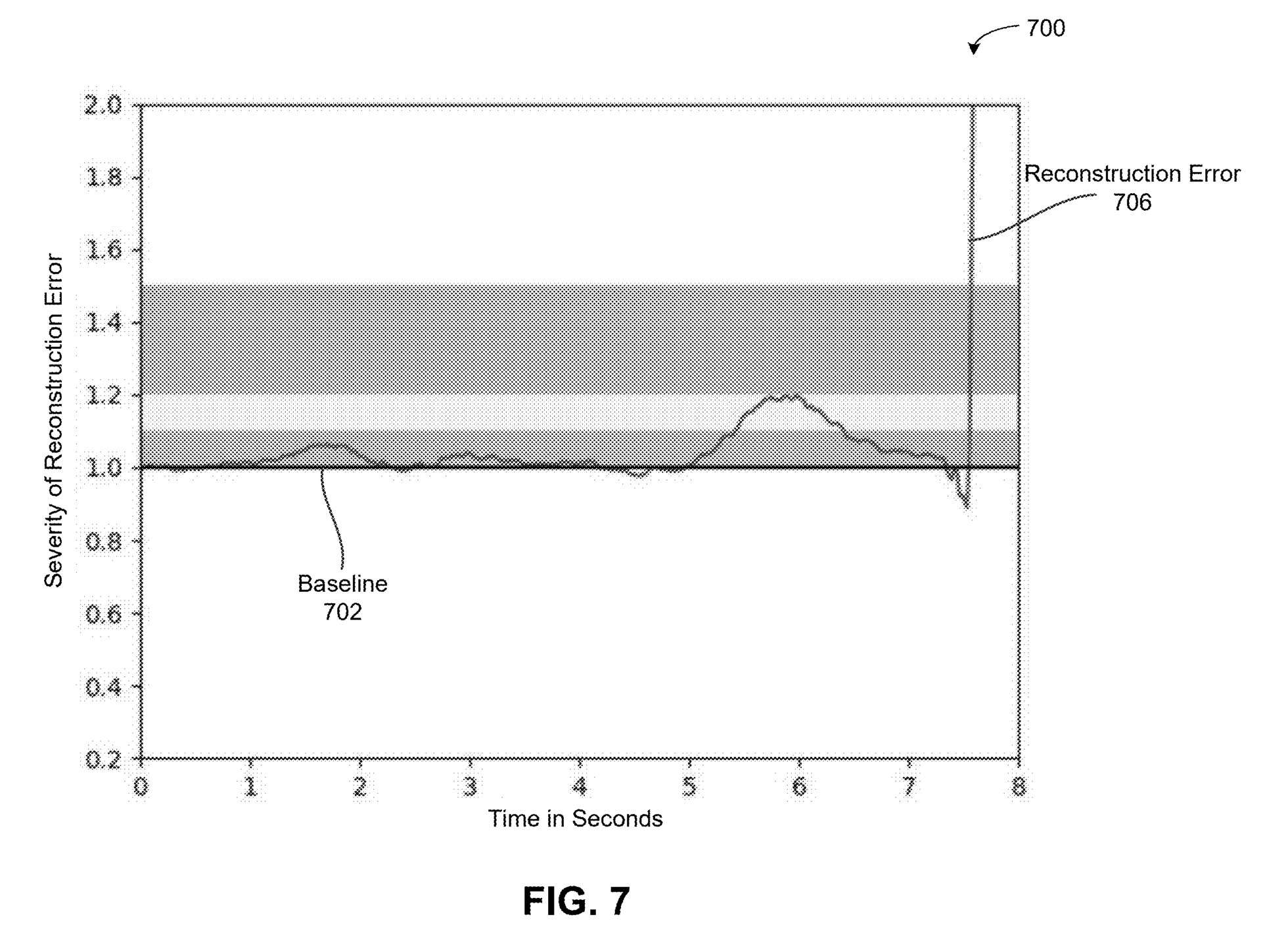
FIG. 7, an example alert chart: reconstruction error for a track switch's eight-second movement, averaged over a day. The line hugs the baseline early, climbs in the back half before easing back, then shoots off the top of the chart near the end. Image: USPTO / Disney Enterprises, US 2026/0287420
A chart like that is what maintenance crews could see in an alert. Disney says the alerts can include "interpretable and informative visualizations, permitting timely diagnosis of mechanical issues that may otherwise have been overlooked."
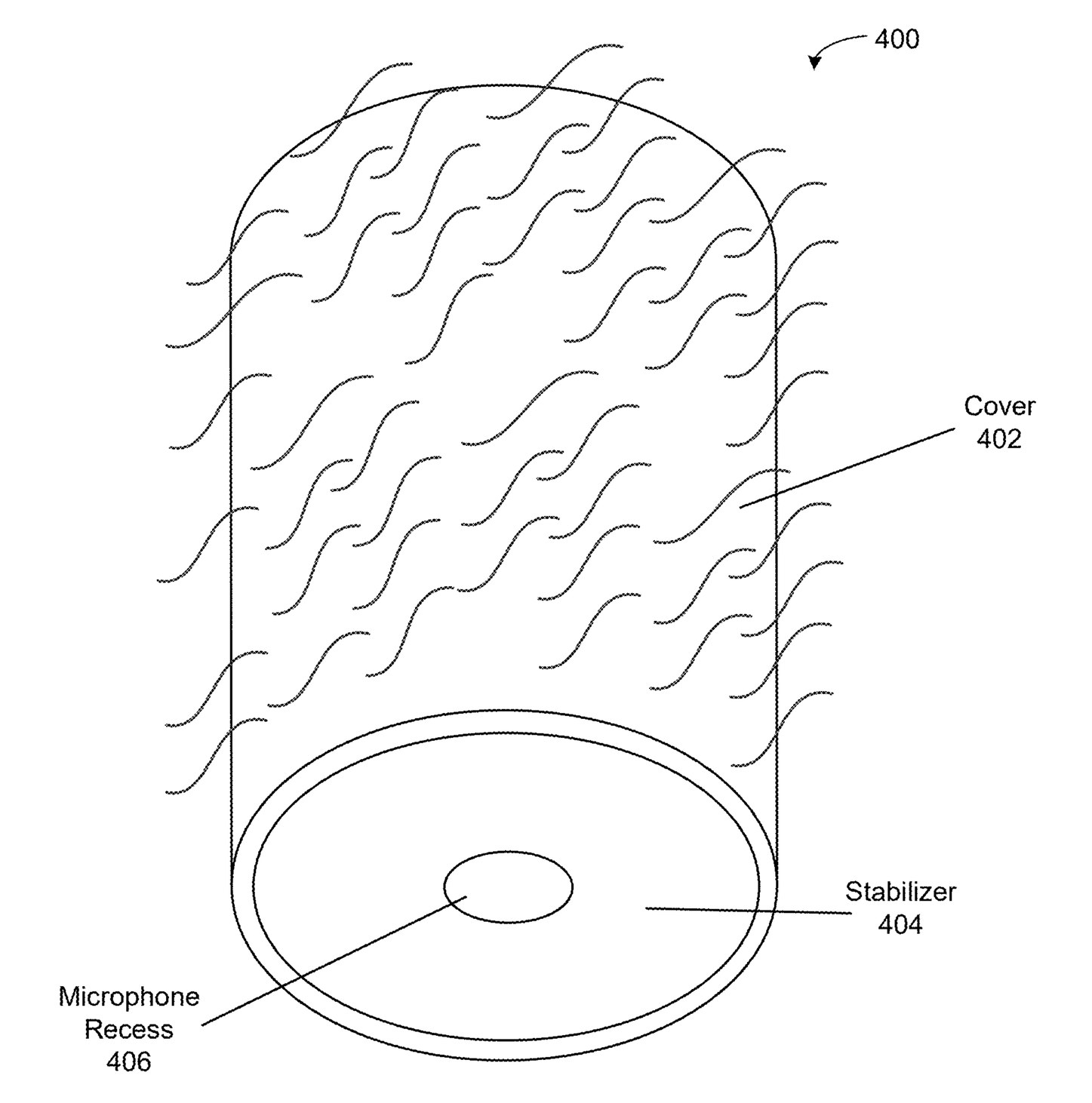
FIG. 4: the wind filter, a fur-covered cylinder with a stabilizer and a recess for the microphone. Image: USPTO / Disney Enterprises, US 2026/0287420
Where this might be used
The application does not name a park or an attraction. Four of its five inventors list addresses in Winter Garden or Orlando, and the fifth is in Granada Hills, California, so the work appears to have a Central Florida team behind it.
As always with patents, this is not an announcement. Blog Mickey notes that "Nothing in the filing names a specific ride, and nothing confirms Disney has built or installed this system anywhere." Patentlyze lists the application's status as "Docketed New Case - Ready for Examination."
It is also not the only Disney filing aimed at ride maintenance this year. In April, Theme Park Insider covered a separate Disney application for a system that would use sensors on a ride vehicle to capture images of parts like a bus bar or conductor rail, and look for anomalies over time. For the AI-wary, Laughing Place makes the point that this one "is not generative AI." It listens, compares, and sends a notification.
Last week we covered another Disney patent filing, for an AI that would spot animals doing something interesting and alert your phone.
Sources
- U.S. Patent Application Publication US 2026/0287420 A1, "Techniques for Detecting Anomalies in Audio Recordings for Predictive Maintenance" (USPTO, PDF)
- Blog Mickey, Disney Wants to Use AI to Listen for Ride Equipment Issues
- Laughing Place, Disney Files Patent to Use AI to Listen for Mechanical Issues on Attractions
- Patentlyze, Disney Patents an AI That Filters Out Crowd Noise to Catch Broken Ride Equipment
- Theme Park Insider, Disney files plans for AI system to monitor ride equipment (April 30, 2026)
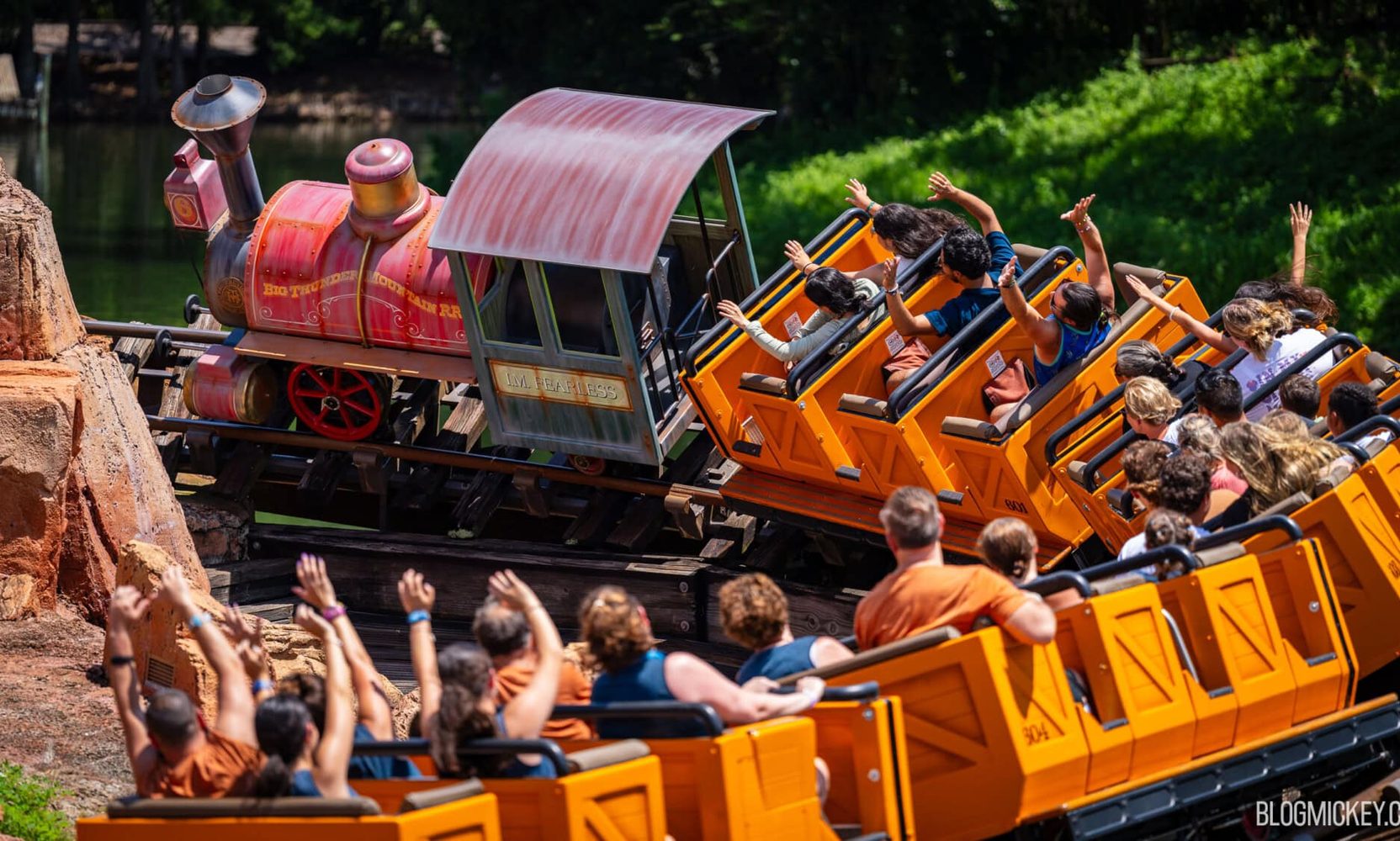
Image credits: featured photo of Big Thunder Mountain Railroad riders by BlogMickey.com (illustrative only; the patent does not name any ride). Patent figures: USPTO / Disney Enterprises, US 2026/0287420.